Fr David Mutters

The Banner Pole Conundrum

Now let’s just think this through…

It all began early one morning when I had to rescue the banner pole out of a narrow box that measured 4 foot high, 18 inches across and 6 foot wide. You get the picture. I couldn’t reach the bottom of this container by simply bending over and reaching inside. What I wanted lay tantalisingly at the bottom. I could see it. It  lay there taunting me.

There was only one thing for it. I got up on a chair and gently lowered myself in, picked up the recalcitrant poles and then… well um…. You know where this is going right?

There I was, in a locked empty church, early in the morning and getting out was going to be a lot more problematic than getting in.

‘Sad’ words were muttered and my doctor would have been very displeased with my blood pressure.

In the end I pushed myself up and very precariously, so as not to endanger my life insurance policy, through a herculean effort managed to get out and emerge triumphant clutching the banner pole close to my breast.

I have made the same mistake many times in my life. To rush in and solve the problem or fix the broken doodad without first thinking through how all this might work. What catastrophes my brashness and overconfidence have initiated along the way. I say inspiring things to myself like …How hard could it be?… Well, let me tell you! Plenty hard. Painting something white while dressed in my priestly blacks probably ranks right up there. What could possibly go wrong?

So when you come across a problem… just stop. First think carefully; consult YouTube if you have to. Just don’t jump in boots and all. Just don’t.

Mutterings from Fr. David

Magnificent in your brokenness 

I’ll call her Florence. Florence is no one and yet she is everyone. She is not one living person or departed, but a collage of people who I have tried to minister to over the years. Tried, floundered, failed, but tried again that very same hour.

Florence was badly crippled with arthritis, had a hammy leg and the chemo she was on made her glorious hair fall out. The nausea was unrelenting and violent.

Florence had ‘not always done the right thing’ and that is Fr. David trying to be nice and understating it. Trouble was she knew it, was quite candid about it and ashamed. She had tried very hard to put the pieces back together as best she could, but there were some parts that were too demolished.

She also knew that she was dying and was actually relieved to give up the drips, the vomit and the chemo.

As we chatted I did not see a broken, tearful and humbled soul who had been ravaged brutally by cancer complete with the swollen belly and sunken eyes. Rather I gazed upon someone else who was magnificent in their brokenness and glorious in their simple, indisputable, unshakable faith. How?

Perhaps, dear readers, part of the answer lies in two quotes that I have unashamedly stolen. The first is from a poet called Gerard Manley Hopkins.  The second is something I gleefully  nicked from Dr. Who.

“In a flash, at a trumpet crash,
I am all at once what Christ is, since he was
what I am, and
This Jack, joke, poor potsherd, patch,
matchwood, immortal diamond,
Is immortal diamond”.

“What if… what if just for one moment... just one, shining moment, you can believe that you are the most important person in the whole world?”

Easter 4

A reflection for Easter 3

In order to see today's mini fillet of fish story in its proper context I think we have to see it against the backdrop of the last supper on Holy Thursday night.

The Last Supper, was a tragic farewell meal, heavy with talk of betrayals and a broken body. Judas nicks off to do what he must, Peter will deny, a kiss betrays the Master. It was night, we are told, and the disciples were “very sorrowful”. They sing a hymn at the end, but we can hardly imagine there was much joy in their voices. For the Messiah who came eating and drinking, this is a grim repast, lightened only by the promise of a heavenly meal to come. Knowing that the band of disciples is already falling apart, Jesus prays that “they will all be one.” But, in a few hours, they will all have deserted him, run away into the darkness and he will walk alone to his death.

How would these feeble friends ever be able to sit down at the table of fellowship again and look him in the eye? There is something very final about the Last Supper — relationships are so damaged, it is hard to see how they will be restored. We sometimes make an understandable mistake when we think that the Passover meal in the upper room was Jesus' last earthly meal. There is a collective Christian absent-mindedness that forgets that Jesus not only came eating and drinking before his crucifixion, but continued eating and drinking after the resurrection. Nothing speaks so powerfully of the joy of the glorious embodied life of the resurrection than a feast shared with others after the fasting of Lent and Holy Week. This mornings gospel records that the apostles found it difficult to accept Jesus’s resurrected body. This  account of the resurrection does not show them joyfully celebrating the risen Christ, but struggling painfully to come to terms with the event. The resurrection joy takes its time coming, and has to seep through a thick layer of human resistance and disbelief. Luke expresses this beautifully in his curious phrase “they still disbelieved for joy, and wondered”. There is hope for all of us yet. For our own sake JESUS must have an “ordinary” resurrected body. If we hope to enjoy the life that he now lives, it must be just like ours,… just as surely as his Christmass body was one just like ours. So today's story  is a continuation of Christmass. God becomes flesh and bones. God  comes into our midst laughing, eating and drinking: Jesus became the flesh of a boy from Galilee, and he was resurrected to the same flesh. The resurrection completes Christmass by showing conclusively that Jesus was not merely wearing his body like a garment of skin, but he was, from the beginning to now, living in his body, as his body and with his body just like you and I. The risen Jesus cooks a great Barbecue on the shore of the sea of Galilee. He eats bread and fish, and breathes on the disciples. The resurrection life is not any other life, but it is this life; flourishing in its completeness and not even human violence can stomp on it and extinguish it. The life-after-death, is none other than the kind of life we experience before death. So Jesus is not resurrected to some abstract, ethereal, wispy, ghostly state of living, but to a particular historical and cultural setting. His resurrected body speaks a language, follows social rules, and interacts with named human beings. Jesus was resurrected into the ordinary life of his friends which includes us.

Something other things to think about.

The last Supper was a highly organised, pre planned event in a specific place, for a specific time. Everyone knew where and when beforehand, although few knew why.The Resurrection meals are spontaneous events that spring out of specific situations: an evening meal, a fishing trip, a visit.The resurrection is an integral and inseparable part of the fabric of our everyday life here and now or as one person put it. We believe in life before death and it will surprise you with its audacity and spontaneity. The Easter event will beg us this week to see it in the created world in which we live and breathe and have our being. The wonder of this encounter with the incarnate God, is not only beautiful, but makes us beautiful. Still, like those disciples  we find it difficult to understand and we are blind to who it is that stands right before us. We will find it even harder to integrate this into the pages of our diary this week. Perhaps it will help if I just fall silent now and let the Master have the last word.

I leave you with three phrases that the  Risen Christ offered his disciples. Listen closely and maybe you will hear Him speaking them to you today.

“Now… you are witnesses of these things….”

“Why do these doubts arise in your hearts?…”

“Peace be with you.”--

Reflection for Easter 2

I thought that we might have a squint at the first reading from the book of Acts. Acts is the story of the early Church written by Luke as a sequel to his gospel. Those who decide what readings we have on a Sunday, put a chunk of Acts for the first reading in Eastertide to highlight the theme of new life. If you watch closely over the coming weeks you’ll see that the early church gets itself into all sorts of bother and there is a serious amount of argy bargy. The most contentious issue of all was the issue of whether new male converts had to be circumcised. That really got both sides of the debate fired up. From our perspective in time we really can’t see what all the fuss was about; but for them when they are right in the heat of the argument, it was a matter of serious contention.

But this morning, we are right at the beginning of Acts, before we get to a church that we might recognise today, it's all smashingly fabulous. The Parish Council of Jerusalem  is working in harmony and has boatloads of cash. Listen to this. “All the believers were one in heart and mind.

They shared everything they had. And God’s grace was so powerfully at work in them all that there were no needy persons among them. For from time to time those who owned land or houses sold them, brought the money from the sales and put it at the apostles’ feet, and it was distributed to anyone who had need.”

Sounds like a dream parish / diocese. Further Luke gives us an example of this generosity of spirit and dollars. Joseph, a Levite from Cyprus, whom the apostles called Barnabas (which means “son of encouragement”), sold a field he owned and brought the money and put it at the apostles’ feet.

So how come…?? How come they have this marvellous attitude? Where did it spring from and what is their secret?

Part of the answer lies in the bit that I have mischievously left out.

“No one claimed that any of their possessions was their own, but they shared everything they had”. They understood that their stuff, their cash, their  bits and pieces, are really just given to them for a little while. And their responsibility was to use it wisely for the good of all. And that is true of us today. Any undertaker will tell you that coffins don’t come with pockets. So now, today, is time to share what we have. A poor example of this is when I can share a muffin at Tosca browns on Thursday. It’s not much but it is a symbol of a dynamic that is much greater. The cash from the book fair that goes off to those in need is a better example. So what else is driving this perception of how flimsy our things are.

I think it's this

“With great power the apostles continued to testify to the resurrection of the Lord Jesus.”

The early church knew that the resurrection of the Lord was not just pie in the sky when you die, with angels and archangels, although that is quite magnificent in itself.  They also understood that the resurrection had important ramifications  for their life on this side of the grave as well.

Once you get that this life is fleeting, swift, precious and that the next life is even more mind blowingly fabulous, then the importance of material bits and pieces that we insist on accumulating .. their importance, value and significance is seen in a whole new light. You begin to understand that what is really important is the life of the world to come. This little life is fleeting and exquisite and therefore any opportunity to help someone else should be grasped immediately.

And this is great news. And it's why the early Church couldn’t keep silent about it, but just had to share it with the world. It is like when you become engaged, or when a child is conceived, or you get the job of your dreams. You simply just can’t keep it to yourself and you have to just share this with anyone who will listen. The resurrection absolutely must affect our lives on this side of the grave just as surely as it will affect our lives on the other side of the grave.

A point to hammer home.

As you read the book of Acts over the coming weeks and watch the early church wrestle in so many ways about so many things, you will discover that they are just like us. But we have the benefit of time. We should know that what is absolutely crucial, die in the ditch issues for us today will be laughable in a thousand years time. Do not give in to Satan's subtle tricks of despair and a hankering for the good ol days or fear of the future. God has put you in this place, in this time, because He wants you here and now and you are exactly where you should be.

Designer Fig Leaves

The Rector's Meandering

Remember the ripping yarn about Adam and Eve and how they realised to their horror that they were naked? They came to this shocking understanding when they had done something they were expressly told not to do.

So they hastily sew some fig leaves to cover the personal parts of their anatomy. Then they hide away, ashamed and remorseful, hoping that God will not see them and if they are found, then at least they have some sort of covering so it really won’t be that bad .. will it?

You would have thought that grumpy ol God would come breathing threats of rage and retribution. Not so.. God comes walking in the cool of the evening and calls to the couple because he can’t see them in their usual place ie. On the verandah in their favourite rocking chairs quaffing a refreshing beverage made from juniper berries or oats.

The story progresses, tension mounts and it is clear that God knows exactly what has happened.. and yet, and yet… still He comes. God knows full well that Adam and Eve are embarrassed and fallible and oozing with guilt. Still… he comes. He comes not because he wants to tick them off but because he simply wants to be with them. He comes knowing full well how fallible we are and what we have done. He even knows the trim of our designer fig leaves. These are just foolish bits of dressing which really serve no earthly purpose at all except to try to cover our perceived shame when in fact none of them are necessary.

It is a good news story. The Master comes to be with us not because of what we have done, but simply because He wants to share that refreshing beverage and gentle conversation.

Easter

A Reflection for Easter 

Jesus said to Mary, ‘Woman, why are you weeping? For whom are you looking?’ Supposing him to be the gardener, she said to him, ‘Sir, if you have carried him away, tell me where you have laid him, and I will take him away.’ 16 Jesus said to her, ‘Mary!’ She turned and said to him in Hebrew, ‘Rabbouni!’  said to Mary Magdalene, ‘Do not hold on to me, because I have not yet ascended to the Father. But go to my brothers and say to them, “I am ascending to my Father and your Father, to my God and your God.”’

As far as I can make out these are the last recorded words of Jesus to Mary Magdalene.

I bet they were ringing in her ears as she rushed away from the empty tomb to the disciples.

The natural thing for Mary would be to stay and to hold onto her beloved Lord but he discourages that.

‘Do not hold onto me…

And then he gives her a very important job to do.

“Go to my brothers and say to them

‘I am ascending to my Father and your father, my God and your God’.”

I hope that there have been one or two times in your worshipping life when you have encountered the Risen Christ. Sensed His very presence even if he was hidden to you under the sacrament or in the face of someone most unlikely. Just for a minuscule  moment, the veil is taken aside and like Mary Magdalene you see who it is that truly stands before you.

It is the most sublime experience and the thing we want most of all is for that moment, that sense of intimacy to last forever. To hang onto it.

And when this exquisite unexpected bubble pops as it must, we are left be-puzzled, wondering if it really did happen and how do we conjure up the experience again. Wouldn’t it be great if we could make it last indefinitely!

Like Mary Magdalene that's not what we are supposed to do. Even after this marvellous act of worship here today there is important work to get on with.

In a little while I will send you out “Go in peace to Love and serve the Lord…”. Go and tell my brethren that He is risen. Jesus' last words to Mary are the words He continuously speaks to us. Yes, this sense of closeness is lovely but… off you go… you’ve got this. Go and tell them that the grave is conquered. He is Risen Alleluia.

Something to ponder on this Easter Day.

In verse one of chapter 20 Mary comes to the tomb and sees the stone rolled away. She runs off, knocks on Peter and John’s door and gets them out of bed. Remember it was still dark when she went to the tomb.

Peter and John run the world's first 4 minute mile to the tomb. We presume that Mary stays at Peter and John’s place while they run off. There is no mention of her joining in with this foot race.

But hey presto, come verse 11, there she is back at the tomb. Why has she come back? The most likely explanation is that she has returned to give vent to her grief which is exactly what she is doing when Jesus appears.

However God has another reason for her to come back to the tomb and that is to give her a very important task. To go and spread the news that Christ is risen.

I wonder how often in our lives we have gone to a particular place, for a particular purpose, absolutely sure of what we were going to do and why we were going to do it. But then something unexpected happens. God intervenes in his quiet, lovely, but dramatic way and we find out that we are exactly where we are supposed to be, at exactly the right time, but the reason for being there is transformed into something quite different, boggling and incomprehensible.

It is not until, much later that we can have the hindsight to look back and think… so that was what it was all about. The Risen Christ was hidden. He appeared to us as someone quite different and yet he gently spoke our name, told us in the nicest possible way to move on and then get on. Go and spread the good news of the empty tomb.

If that has happened to you.. then how blessed you are. Go and tell the brothers and sisters that He IS risen. He is already here with us and He is awaiting us when it comes our turn to be laid in our tomb.

Some Mutterings

Some mutterings

I was watching an elite sporting event the other day. It was an exhilarating competition and of course someone came first and someone else came second. The second place getter did not lose graciously and expressed their deep regret at coming second.

I was a bit thunderstruck by this. At the running and swimming races at school I was always so far behind, some wondered whether I might not be competing in the next race. I mean, if I had managed to get to TV level and play as well as they did, then I would be uncontrollably ecstatic. To play in front of throngs of people, representing your country is an enormous privilege. Of course the player got heaps of media attention because of their angst and unhelpful words.

And pondered as I waited for the kettle to boil.

When did coming second in any sport, at any level, become a source of shame and regret? Is it really such a life changing disaster? What happened to the joy of just simply participating and giving something your very best shot? Is it a terrible thing to be inspired and challenged by a more worthy opponent?

Don’t get me wrong. A bit of healthy competition can push us along and bring out our very best effort. It is what happens at the finish line and some post match speeches that have left me scratching my head and stroking my chin in bemusement.

There is another question which goes to the heart of the matter and I would ask it of everyone that enters any competition or plays competitive sport. And my question is this. ‘Why did you enter the race?’ If your answer is to win and only to win at any cost, then my friend, I think you have lost already.

Derek the Donkey

Meet Derek the Donkey

Today I wanted to reflect on one of the more significant characters in the Palm Sunday story. In fact some biblical commentators say that this person's role was absolutely vital. Meet Derek the donkey that carried Our Lord into Jerusalem. There are a few pertinent things about Derek. First, Derek was chosen specifically for his role. Read the good book carefully and you’ll see that Jesus chooses Derek. Not Dave, not Delilah, not Dawn not Darcy or  even Danny.  No, Derek is the donkey that Jesus wants.

“Jesus  sent two of his disciples and said to them, ‘Go into the village ahead of you, and immediately as you enter it, you will find tied there a colt that has never been ridden; untie it and bring it.”

Moreover Derek is needed. The symbolism of the King riding the lowliest of beasts would not have been lost on those who lined the streets and it must never be lost on us. It is crucial that Derek shows up.

Now it is a little known fact that Derek actually went grudgingly. He was about to whoof into his feed box and he had his eye on a pretty young donkey that had just been introduced to the herd. So of course when these two strangers show up out of nowhere with a task that was not in his job description, Derek is more than a little put out and goes reluctantly with the disciples. Still with a full tum tum and a wicked twinkle in his eye Derek sighs heavily and goes off to do as he is asked. He’s really not quite sure about this task put quickly realises that the guy on his back is someone that is good at gently steering. He’s the sort of passenger that engages you so that you really just want to assist. It’s a long haul but as they get closer to Jerusalem Derek is just pleased to be able help because he has grown to rather like his passenger.

As he trots along Derek hears the crowd and he can tell that they are excited and cheering. As he gets closer to Jerusalem the crowd gets bigger and the shouts get louder. Then he hears his first “Hosanna”. The word is picked up by the crowd and pretty soon everybody is shouting “Hosanna!” Derek's ego begins to swell. Even the pretty young filly back at the stable is forgotten, such is the verve of the crowd. “Hosanna, HOSANNA!” chant the crowds. This is the most fun and the most fuss that Derek has ever experienced in his  three years of being a donkey. ‘They love me… They need me’ he thinks… ‘What can I say?’. But here’s the thing. After Jesus' triumphant entry into Jerusalem, Derek is never mentioned again. He disappears from the pages of the bible just as swiftly he appears.

Now I tell you about Derek because there is a little part of him that is all of us. Sometimes we are asked to do things and go places where we would rather not. Like fessing up, like trying to chat through difficult issues that are tricky, and maybe just getting our stuff together so that we can find ourselves at the altar on a regular basis. Like finding a line in our family budget for God. But God has chosen us specially and specifically for a particular reason. Like Derek, we may not know about it, we might never understand it, we might think it is a frivolous waste of time; but there is a reason for this. We might never be able to see the bigger picture and how we fit into the grand plan of things. But our role is crucial in God’s eyes and while we might come dragging our feet, with heavy hearts and muttering to ourselves and anyone else who will listen, still we come. And notice please that Derek doesn’t have any lines to speak. Perhaps we are most effective when we keep our counsel and listen. And what are we to make of the Hosannas. Dear Derek thought they were for him and this is the part where you can have a mini doze because this next point is for clergy. The message of the Hosannas is that the cheering is always for the Master. It’s not about the priest or dare I say it, about Bishop Gary. It is always about The One true High priest. The one on the donkey, not the donkey himself. And the good news… If God can use Derek the donkey in the triumphant fulfilment of his plan, then he certainly has a plan for me and he most certainly has a plan for you.

Cradle Mountain

One Step at a Time

This lesson was learned the hard way on Cradle Mountain. The views were amazing and the path was long. We walked at a brisk pace for over two hours. It was an invigorating experience and we felt honoured to be on holidays in this amazing part of the world. Frequently steps found us. The longer we walked the more arduous and bewildering these steps seemed to become. Almost as if they had a taunting life of their own… daring us to try and conquer them. As we neared the end of our trek (a part of me not really wanting the experience to be over) a particularly challenging set of steps sneered wickedly down at us.

I sighed, looked up and in one of those rare moments that only happens every 2,865 days, I thought ‘Well there is only one way to do this and that is one step at a time’. Trying to do any more than one step at time would be as foolish as jumping off a wardrobe.

I thought of this rare and precious insight as I looked at my list on the desk this morning. The list seemed long and inexpugnable. And then Cradle Mountain and those steps came back to me.

“OK” I muttered, fruitlessly trying to inject some determination into soul. “We’re just going to do this one step at a time.” It did not make the list go away, just as those monstrous steps did not vanish at Cradle Mountain. But at least there was a way forward, a methodology, a plan of attack.

Perhaps, like me you too have those moments or days where the task bewilders and befuddles you. If so, remember that you are not alone and together we’re just going to do this one… step… at… a… time.

Sir, We Wish to See Jesus

A reflection for Lent 5.

“Sir we wish to see Jesus”

In today's gospel the shadow of the cross looms ever closer  and darker. “Very truly, I tell you, unless a grain of wheat falls into the earth and dies, it remains just a single grain; but if it dies, it bears much fruit” We are right to prickle and cringe at the sense of foreboding and I want to come back to the cross a little later. Sometimes, just sometimes, when I am reading the good book a one liner reaches out from the pages and smacks across my left cheek. I hope occasionally this might happen for you too.

In today's gospel it was this line. “Sir we wish to see Jesus”. It is spoken by Greeks who normally would have been considered outsiders; but no… here they are at the festival, wanting to worship and wanting to see Jesus. We are not told about their motives, whether they had a shopping list for Jesus or whether they were just down right curious. Maybe they were just wanting to jump on board  with the latest and most controversial fad. We are not told if they got to see Jesus. We are not even told how many there were. For some reason I had always assumed that there were just two. But read again Fr. David. We are not told. In fact after their request, they are never mentioned again. They are one of many people who frustratingly disappear from scripture and we are left scratching our heads wondering whatever happened to them.

***“Sir, we wish to see Jesus.”

If we are honest there are times in all of our lives when we have echoed that line if not out loud, then certainly deep from our heart. We wish to see Jesus. It is one of the most authentic prayers that we can offer. It doesn’t try to pretend that things are lovely, sweetness and light and smelling of roses. It simply tells it as it is. So if you find yourself uttering this prayer at any stage, for any reason, then it is not a sign of failure, but rather an indication that you know how much you need him and you have come to the right place. A gold star to you.

But where do we see him? Here are a few classic places that you might glimpse him.

In the face of the unexpected stranger who is sent into your life. They might be just like the Greeks. People who just brush against your life and then are gone again.

Then there are the people who drive us nuts. Yes, those who we know we will never agree with, who hold vastly opposing views to our own, who have that irritating habit of getting under our skin. These are the people who stretch us, challenge us, infuriate us and in their aggravating, exasperating ways make us think again, ponder and wonder. They stretch our thinking and our patience and perhaps that is not such a bad thing.

We find Him of course in the sacrament of the altar. This is my body. Nothing more, nothing less. We have His promise for it and we do what he has asked of us.

We see Jesus in the face of a friend. That confidant, that special person who knows all our eccentricities. The one who knows our frailty better than we do. The one who has a twinkle in their eye and a winning smile whenever they see us and we know that we are going to get a good hearing and sage advice.

If we are very patient we might also see him in the mirror. This might seem completely mad, but strap yourself in and just go with me on this.  If we glimpse the Master in others is not also likely that they glimpse Jesus in us. Surely that must be possible, if not probable, if not certain.

And finally we glimpse him the crucifix. This is love made visible. The image of Jesus with his arms wide open on the cross to embrace us. The crucifix says. “This is how much I love you. This is what I am willing to do for you.” The mangled man on the cross is the loving face of God looking at us.

Sir we wish to see Jesus.

I suspect that there are times when we are grouchy and we really want to see Jesus and give him a piece of our mind. Or maybe we have a “to do” list for him. Dear God, you can start by…. Let me tell you… and then you can…There are other times I suspect when we might have a guilty conscience and we are really not quite sure that we want to see him at all. If you’re anything like me then you flit quickly from not wanting to see him, to really wanting to see him very much. As I speak, in this fleeting second, I don’t  really know where you are up to. But this much I do know. I do know that He sure wants to see you.

Outside a City Wall

Fr David Muses

I had the privilege of going to the Penshurst cemetery the other day. I was struck by the distance from the town centre to the cemetery itself. This is not in any way a criticism, but rather an observation. The phenomenon of ‘camouflaging’ death is evident in every parish I have served in. The cemetery is placed away from view; away from our thinking and consideration. We don’t want to confront it. It’s almost as if we have tried to pretend that death does not occur. By placing it at the periphery of our town limits, we can conveniently and swiftly forget about it.

Further, it’s as if we are ashamed of sister death. The unwelcome guest who mucks with our lives. An inconvenience. The Master was crucified well outside the city of Jerusalem for this very reason. He died a criminal's death and therefore died outside of the city. Even in a death; a humiliating, naked death, the location says it all. The place of his death clearly speaks the message that this man was a low life, an embarrassment, a recalcitrant. He was a no gooder and we are going to forget about him as quickly as possible.

I actually view it slightly differently and look at the telescope from the other end. I actually think that it was a helpful thing for the Master to die ‘outside’. The message for me is that there is no place that is absent from God’s love. No matter how far we might have strayed, no matter how alone or forgotten… even in death, especially in death, He is there for us, with us and leading us home. The encounter with the other crim on the cross says it all. ‘Today you will be with me in paradise’.

New Roof

Hooray!

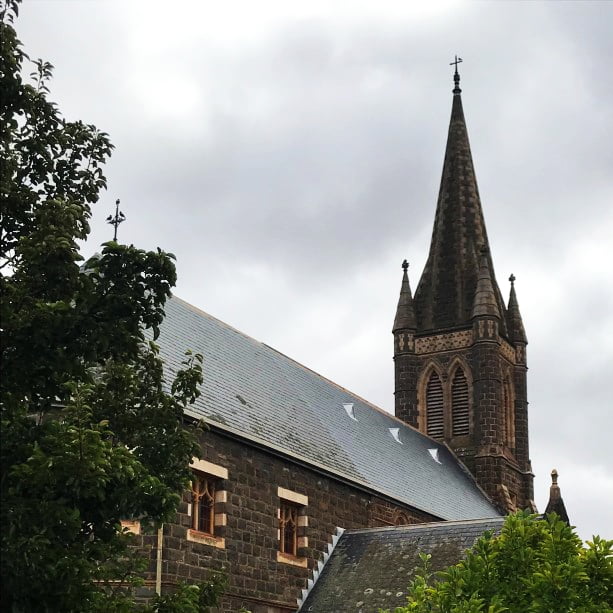
So work has finished on one side of Christ Church roof.

Hooray!

That's exciting and a huge buzz.. but please remember... the only reason this has happened is because you were generous and supportive. It is your work just as much as the workers.