Peter Smith aka …

Peter Smith … not his real name.

One of the regional towns I found myself in was a town called Bullamanka. Not its real name. And one of the senior elite gentlemen of the hoypaloy of the Bullamanka was Peter Smith. Not his real name.

Peter did a lot for Bullamanka and, for a while, was even chief Poobah (not the real title) of Bullamanka. He painted the local footy shed, mowed the grass outside the Senior Citizens building and even visited the Rest Easy retirement home on the first Thursday of every second month. What a guy!

Well, you know how these regional towns all have their own folklore…and all the characters have their stories… Well, Bullamanka was no different, and Peter  Smith was no different.

But Peter Smith, like all of us, was flawed in more than a few ways, and one of the legends about Peter went like this.

On the evening of a significant birthday, Peter Smith (not his real name) was driving home when he was stopped for a routine breath test. To be fair, the policewoman was only doing her job when she flagged Peter down and asked him if he had anything to drink. Peter never lied and confessed to having a few raspberry milkshakes. Peter dutifully blew into the breathalyser that was offered, and the policewoman kindly explained that he was over the legal limit and courteously asked if he would mind stepping out of the vehicle and producing his licence.

Peter could see that his illustrious reputation would be in tatters if the matter proceeded any further, and it is alleged that he said something, kind of like this.

“You can’t arrest me. I’m Peter Smith” (not his real name). “I’m terribly sorry, Sir…” the policewoman began. But Peter was quick off the mark. “Peter Smith has done this for Bullamanka, Peter Smith has done X Y and 3.4 for Bullamanka, I’m the local Poobah and president of the Really Intelligent Peoples Club. I’m Peter Smith, rock and pillar of this community.”

The sorry tale tells of a deterioration in the quality of communication and it is alleged that Peter Smith finished his travels that night in quite a different vehicle, to quite a different location with his name and photo appearing on the front page of the Bullamanka Express the next day with a rather more fulsome article and two more photos on page 3. In fact, there was some fear that the story might diminish the size of the sports report… let it never be said.

Peter Smith could easily have been a figment of my imagination, or he could easily have been like any of us here and especially like St. Peter of old.

In fact, Peter Smith very much reminds me of St. Peter of old. Dashing about with voice and deed, always willing and wanting to do the right thing, but secretly or perhaps not so secretly, his brashness getting him into strife. ‘You are Peter, the rock on which I will build my church’ says the Master, but the briefest of looks at Peter Smith or St. Peter of old, or especially in our bathroom mirror will show us that we are actually just shale and rubble.
That we are a little bit crumbly and flaky around the edges. There are flaws and bumps that embarrass us. And when, like Peter Smith, someone points these fractures out we can easily ark up, toss the toys out of our cot, and offer a litany of our attributes and plusses.

A quick look around at the other apostles and those who join us in worship reveals a puzzling but lovely anomaly. It seems that with a giggle and smirk, The divine rolls up his sleeves and delights in choosing the Peter and Pam Smiths of this world to do some of his most important work knowing that their hearts will be broken as well as filled with joy. The flinty  and the shonky are our friends and fellow worshippers. Our bibles are choc full of some of the shadiest characters you could ever hope not to meet.

It is always a privilege to worship and enjoy the company of those who are actually not plaster saints. I identify so strongly with and have much more in common with those who come from places like Galilee or Bullamanka or Nazareth. Can anything good come out of Kalangatuk west or Sheephills?

It is in and through the shonky characters that I see God working most powerfully and exquisitely and beautifully. God does some of his finest work through the Peter Smiths of this world. Our tumblings are His opportunities to reach out with his pierced hands, hold us and say again ‘Peace be with you’. Trips in the white van with the pretty lights on top are the  beginning of an exciting new adventure. I would be intimidated and abashed by a church full of perfect people. I would not fit in and belong. Give me a church full of St. Peters, of Peter Smiths. Give me a wounded Body of Christ who shows off his ruptured hands and feet. This is where I belong. With the grubby, the needy and the redeemed. May St. Peter and Peter Smith and you and I continue to pray for each other Amen.

The Fear of Relapse

22/6/25

The Fear of Relapse.

In 1976, I read the book The Exorcist. I was an impressionable youth, and I can still recall that today’s gospel is quoted in part on the flyleaf of the book.

The story of the tortured naked guy living in the tombs of Gerasenes would make for great television, especially the whole swine charging down into the sea.

The stories we get on our news feeds, whatever yours happens to be, are often heavily laced with fear. Hence, we get fire, flood, road accidents, the taking of life, and you can probably think of a whole lot of stories you’ve seen recently where there has been an element of fear. Check out the questions that the interviewer asks.

Are you worried that

Do you think that…

What would be the worst possible scenario for ….

Can you confirm that this incident won’t happen again?

Our gospel today is also heavily laced with fear.  The locals fear of the possessed man. Their fear of Jesus, remember, they sent him away at the end of the story.  The demons' fear of  Jesus.

‘What have you to do with me, Jesus, Son of the Most High God? I beg you, do not torment me”

Right at the end of the gospel, there is a curious little conversation between the exorcised man (Let’s call him Frank) and the Master.

Frank asks to stay with Jesus, but Jesus sends him away, saying ‘Return to your home, and declare how much God has done for you.’

Now, it’s not explicitly spelled out here, but I think that Frank wants to stay with The Master for two reasons.

First, his liberating experience would be such a pleasurable thing that, of course, he would want to stay close to the source of the one who has so richly blessed him.

But mixed through and folded into this desire is another fear. The fear of relapse.

Perhaps in Frank’s mind is the fear that if Jesus leaves, then the demons will come back and possess him. He would be back to his old way of ditching his clothes and being tortured in mind, and he really would prefer his cleaned-up self just the way he his, thank you very much. There’s something about Frank’s trust or lack of it in all of this as well.

The fear of relapse is a very understandable and logical dread. I have met some folk, who, having recently been given the ‘all clear’ really aren’t quite ready to accept the gift, grasp and live it for fear that it might be an illusion. You see the scenario… perhaps you have lived it or are living it yourself.

The fear of relapse is a thief because it robs you of the present. All those exciting things that you can and should be getting on with and enjoying right now.

The fear of relapse is a thief because it robs you of the future. I might relapse in 6 months, 12 months time and therefore I can’t plan to do 6.5 and Y, T and Z

The fear of relapse is a thief because it robs you of the ministry of those who want to reach out to you and serve you. You can become so self absorbed that you miss out and your friends and family miss out.

Still with me? Good. Now just to add to my completely unprovable theory I reckon that the Master understands that Frank suffers from the fear of relapse and so to remedy his anxiety he gives him a task to combat his fear.

‘Return to your home, and declare how much God has done for you.’

There is something about the telling, of the speaking out loud that makes it real. For example, the retelling of a grim prognosis or the spruiking of your tattslotto winning makes your big news more real. The more you pass on your news, the more concrete it becomes. Yes it really is all happening. My winnings, prognosis is factual.

And it is most certainly true when we hear the gospel read. It’s not just a retelling of a nice Jesus story. Jesus speaks to us and his message becomes palpable to us and our hearts burn within us.

Henri Nouwen articulates this beautifully in his book ‘With Burning Hearts’

“The Word of God is sacramental. That means it is sacred, and as a sacred word, it makes present what it indicates. When Jesus spoke to the two sad travellers on the road to Emmaus and explained to them the words of scriptures that were about himself, their hearts began to burn, that is to say, they experienced his presence. Speaking about himself he became present to them. With his words he did much more than simply make them think of him, or instruct them about himself, or inspire them with his memory. Through his words, he became really present to them. This is what we mean by the sacramental quality of the word. The word creates what it expresses.”

So, what would happen if we did what Frank did and went and declared what God has done for us? Would not our fear of relapse evaporate, and our hearts burn within us?


From Priest to You

From the Priest to You

Today's reflection is about no specific person but rather a collective collage of faithful people whom I have had the privilege of serving in the parish of Hamilton.

Sunday by Sunday, day by day, you come and sit on hard wooden pews and in blithering, biting cold and stinking unforgiving heat, mutter your prayers and sing the hymns to the unseen God.

Each one of you is richly endowed with enviable talents. From the chorister, the handyman, the flower arranger, the statesman, and the gardener.  From those who quietly visit and listen, to those who light and extinguish candles, set up and pack up.

Your work is largely imperceptible, but your laughter and conversation are often audible, and your countenance is always welcoming. Your giggling is contagious, and your prayers are like an all-encompassing doona that is comforting and consoling.

There are those who challenge me, to think and pray. They stretch me in all sorts of ways and help me to aspire to giddy new heights of wisdom and discernment. I owe them a particular debt, for they taught me the invaluable lesson that ‘You can’t unsay things.’

And there are those who have suffered piercing, ferocious heartbreak and rather than bow down  to the insatiable Gods of anger and bitterness, have risen from the ashes, understanding that their tears and their bruises are actually the marks of their magnificence.

To be immersed in such wildness and wit in the western districts is a privilege I did not seek and one I certainly do not deserve.

Month by flitting month, in all my encounters, you selflessly show forth a faith that is courageous and rapturous. In smashingly good times and in the despair of drought, your  faith is the one thing that I have come to rely on and enjoy.

And if you can do it… ???

Trinity Sunday

Trinity Sunday

My friends who are Glen.

Many of you have patiently endured preacher after preacher, year after year, trying to explain the Holy and Blessed and Undivided Trinity.

With great fortitude and resilience, you have watched and listened as preacher after preacher failed in spectacular fashion to reach the dizzying theological heights of announcing and clarifying that which never can be articulated.

So, rather than try to achieve the unachievable, I thought that I would talk about three of my good friends, all of whom happen to be named Glen. All three of them are heartwarming, engaging, bonhomie comrades indeed. All of them, quite distinct and yet all of them have a great deal in common. In fact, they are so similar that I wondered whether there might be something in the name ‘Glen’, so I had a look at a screen and discovered that

Glen means 'a deep, narrow valley, especially in Scotland or Ireland’. More about this later.

First, I’d like to introduce you to Glen the gardener.

Glen faithfully tends the soil and has watched over his patch of dirt for decades. His greatest thrill is to plant tiny seeds in the ground and watch them sprout, grow, flourish and then ultimately harvest his well-deserved vegetables and flowers. He also has the hobby of creating superb clay earthenware pots and statues. His work is to be admired, and it is always inspiring. When you gaze upon it, you find yourself in a different space. You can’t help but want to imitate Glen’s creative genius and rush home to your patch of dirt and make something wonderful.

Then there is  Glen the priest. I have known him for pretty much all my ordained life. I have seen him at some of his finest moments, and some of these are noted publicly, and they are shiny and lovely. But there are other times when I have seen him broken, and he has seen me broken. There in the spaces where no one sees and no one will ever know, we meet each other in our fragile and hurting selves and discover to our delight and amazement that we are not that much different after all. He admires the gifts that I hide from myself, and vice versa. Over the decades, he has generously and selflessly poured out his life in the service of others, often at great cost to those who are closest to him and always at great cost to himself. His life has been a sacrifice that has enhanced and sanctified all who have touched the hem of his garment.

Finally, there is my good friend Mr. Glen Livet. Mr. Livet boasts an ancestor, Mr. George Smith, who lived in a secluded valley in Scotland. It’s an isolated place, and just as well because Glen’s ancestor George was in the illegal distillation trade. When the legislation changed, George did the right thing and acquired a licence and the company. In his chatter, I have always found Mr. Livet balanced and nuanced. To engage and indulge him in an encounter is an experience that is both indescribable and unforgettable. He also has a distinctive type of aftershave which I can only describe as having traces of almond and spice. A talented musician he can produce alluring melodies with sweet velvety notes which leave you glowing and relaxed. He has always fired my imagination and warmed the cockles of my heart.

Time to fess up.

When I first wrote this homily, the other two “Glens” were actually Mr. Glen Morangie and Mr. Glen Fiddich.

I was going to make the point that all three are fine whisky, all are expensive, all are flavoursome and yet each is unique and distinctive, which makes it a fun but flimsy parable for the Trinity. It was a frivolous homily indeed, and at the very least, you deserve an attempt to do better.

So I decided instead to talk about Glen the Gardner, a type of God, the creator Father, Glen the priest, a parable for THE priest, and I selfishly kept Glen the distiller for the Holy Spirit.

None is better than the other. Each has its own unique quality, but they are not identical. They are never in competition with each other, just as members of the Trinity are never in competition with each other, for the Trinity is of such love that it can never be divided.

But like all images, it can never describe who God is, for God is completely ‘other’. We can go a part of the way, but never all the way.

For example you can never have too much God, but you can have too much whisky. There is a significant cost when you buy whisky, but God’s grace is free and you can probably think of other ways in which my little images must inevitably fall over under the weight of necessary logic.

This homily may not have taught you much about the theological academic intricacies of  God. But that is not the most exciting or the best bit about God. The most intoxicating part about God is just getting to know him, enjoying him and savouring him.

So perhaps you might forget everything I’ve said and just grab a glass and do the obvious and the wonderful.

I have caught me a screen and it will not let me go

I was privileged to go to an exhibition on the history of the Notre Dame Cathedral last month.

Normally, you would expect to admire photos and gaze at bits of information on easy-to-read plaques.

Instead, we were given something like an iPad, and the process went something like this.

You held the screen over different pictures, and information appeared on your screen, including little movies and pictures. Within each station, there was a wealth of information, and there was even a bit of a treasure hunt and puzzle to solve if you were that way inclined.

A lot of work went into the production of all this, it was beautifully presented and there were some definite plusses.

For me, who is short of stature, it meant that I wasn’t stuck behind someone of larger stature bobbing around, trying to catch a glimpse of something gorgeous. I could take my time just gazing and tapping at the screen in front of me.

But there were some things that were missing. For one thing, there was no interaction with the other patrons. There were probably about 40 of us, just staring longingly, deeply into a screen. Each of us was seeing the same thing, but not talking about what we were seeing. The soft caress of conversation you normally get in a gallery was replaced with stony silence. We were together, in the one place, seeing the one thing, but we were not connected in any way. While I get the economics of it and the razzle-dazzle of the screen is addictive, I missed the connectivity that comes with an ‘old-fashioned’ exhibition.

We have caught the screen ... and the screen has caught us, and it will not let us go.

Jesus the Scandal…and Miracle of Pentecost.

Jesus, the Scandal…and the Miracle of Pentecost.

In today’s gospel, Philip's words could well be mine or yours.

“Show us the Father, and we will be satisfied.”

We long to see the Father. We would ache to reach out, to touch, to know, to engage, to gawk and chatter. For most of the time, we walk blindly in faith, stumbling along, hoping, glimpsing, sometimes sensing, getting a slight ‘whiff’ of the divine. A cursory little glimpse out the corner of our eye. A set of circumstances that tumble down in front of us in a way that we could never have envisaged or hoped for. Puzzling and alluring. But,.. that’s just about it.

There is a line of logic which says that we as human beings can never really ‘Know’ God. Not know Him completely in all his infinite glory. Our minds and hearts can never take it all in, and his ways and purposes are baffling, frustrating, bewildering and incomprehensible to us. If God is completely ‘other’… What hope do we have? And yet.. and yet. We long for the miracle of Pentecost.

Perhaps it is Philip’s obvious and understandable yearning that is the best proof that we have. ‘Show us the Father and we will be satisfied.’  Now, where did his desire come from? There is clearly a longing within Philip where he kind of knows, wants to know more and yet,… isn’t quite there … yet…

‘Show us the Father and we will be satisfied.’

Or would we? Would one solitary interview, one photo, one prod at his piercings ever really be enough for us?

Jesus’ firm response to Philip, maybe it's even a chastening, is to point to the indivisible, unbreakable, indissoluble unity that Jesus and His Father have.

“I am in the Father and the Father is in me. The words that I say to you, I do not speak on my own; but the Father who dwells in me does his works.  Believe me that I am in the Father and the Father is in me; To have seen Me is to have seen the Father.”

And I suspect that there is a clue here. When we see the same unity amongst ourselves, when we are in harmony one with another, then we have a fleeting peep at the face of God. In our fractious world, it doesn’t happen often but I have been privileged to watch it at what might seem an odd place. And that place is the arrival area of Tullamarine Airport. Hugs, flowers, balloons, tears and passionate kisses are all around.

At that ached-for moment, when the face you long to see emerges from the sliding glass doors, there is nothing that you wouldn’t do for them. Even getting up in the middle of the night to be there, sleep deprived and hair askew, is no hardship, but on the contrary,y it is a thrill and a joy. Where else could you be? Who else would you be with?

So it is with God.

The Father we see in Jesus loves the world, lays down his life for us, is not ashamed of us, but actually invites us to dwell with him forever. This is the ferocious passion with which He loves us. This is His deepest and keenest desire.

The Father we know is the judge we love.

And yet… The Jesus we meet is a scandal.

There is no solid proof that this is the one. There is no absolute certainty that we have made the right choice. The Father we see in Jesus is not the noble, exalted, all powerful man we seek, but He is a jew who died crushed on a cross. How macarbe.

Yet the Holy Spirit that the Master alludes to in today’s gospel teases us, allures us, taunts us, dares us to follow and dance.

And just sometimes in a moment of weakness… or is it strength, we are convinced that this crucified one, this pushed aside one, this downtrodden, this rejected, beat up, spat upon, mocked one, is truly The one; the face of the Father, the heart of God. The miracle of Pentecost is that we believe, however feebly and however fleetingly.

Perhaps the miracle of Pentecost is that even today, after all this time, people still gather together to worship the Father, Son and Holy Spirit.

There are still people who keep watching, hoping, longing, waiting, like the bedraggled folk at Tullamarine.

There is still a worshipping community that craves for the new creation and longs for a peek of God’s face.

The miracle of Pentecost  is that there is  still a community of people who long to carry each other’s burdens.


Now when we gather to celebrate Pentecost there is always a temptation to celebrate it as a nostalgic event of the past and remember the ancient Pentecost. John will not allow us to live in the past. The work of the Holy Spirit  is and must be a present work. Greater works than these are alive in us who in spite of our “Philipness” confess that the bruised and risen one, this embarrassment pinned to the cross, truly is our Lord and God. And that we can make this confession with a grin on our face and a flush of excitement in our hearts, is the finest miracle of Pentecost.

How Do You Get a Life Like a … Seal?

How Do You Get a Life Like a … Seal?

It was a superb day for a walk as we clambered along Cape Bridgewater. The walk has magnificent views, and it's got a bit of undulation to make sure you get a healthy amount of exercise. We paused at the end of a section and peered down. Way below us, there was a bob of seals.

There they were, just splashing about in the waves and generally having a wonderful time. I’m sure I saw a couple of them actually catch a wave and ride for a while. They jumped and frolicked as if they had nothing better to do. There was no thought of time limits, deadlines, meetings, argy bargy and sadness. All they did was simply muck about in the water.

I came away envious and puzzled. I mean, for one thing, how do you get a job like that? Something where you just fool about and have a lovely time doing what you were supposed to be doing.

And why, when and how did we make our lives and world so complex, bewildering and complicated? It seems that all the seals achieved is to develop a penchant for fresh fish while we, who are the more ‘intelligent’ creatures, have invented nuclear warheads, firebombing, courts, carjacking, domestic violence and financial scams.

Part of the answer to my dilemma is that some people, and they are in the tiny minority, have chosen to push boundaries and break rules. They have chosen to see their rights as more deserving than the other. Thus, there have to be rules and this goes way back to those things called the 10 commandments.

So… how do you get a life like a seal? Maybe it has something to do with just staying within the lines. Perhaps the laws liberate us, not confine us.

Meet Tabitha and Elisha

1 June 2025

Meet Tabitha and Elisha

Today’s gospel has some outrageously good news for us. In fact, it is stonkering in what it claims.

Today’s gospel is from John 17 in what we call the high priestly prayer. Jesus the High Priest is praying for lots and lots of different people and lots and lots of different things.

He prays for those who will become believers in the future, those who, through his disciples' ministry, will come to know the Love of their heavenly Father and his Son.

So we get

“I pray also for those who will believe in me through their message,”

He prays for unity amongst his disciples.

“that all of them may be one”

He prays for his apostles and asks for two things for them.

First, that they may be with him.

“Father, I want those you have given me to be with me where I am,”

and secondly

That they may see the glory of God.

 “and to see my glory, the glory you have given me.”

He prays that the world may come to believe that the Father sent Him and the disciples may know that they are loved.

“I pray that the world may believe that you have sent me and you have loved them just as you have loved me.”

And this is the really good bit.  The same love that the Father has for Jesus is the same love that God has for us. The ferocity and passion and tenderness and eternal love that God lavishes on his Son is the same ferocious and passionate and tender and eternal love that God lavishes on … you and me.

And the word ‘know’ occurs no less than 5 times in the gospel reading. And it is a special kind of knowing. It is not an academic book knowledge like the square root of 9 is three or the chemical formula for water is H2O.

So if it's not “book knowing” then what sort of knowledge is it, and what would be an example of it?

Introducing Tabitha and Elisha. Here are two people who, when you look at them, you “know” that they are together. They are a single body. There is a cohesive, electric atmosphere around them that is almost material and touchable. What’s more, they themselves know they are together. With every fibre of their being, they know each other and they know they are together.

And that I think others and sisters is the closest we get to understanding the sort of unity that God the Father and his Son have with each other.

“Just as you are in me and I am in you.” Except, of course, that the unity that the Father and the Son have is never marred by sin, by the quick word, by the irritations that Tabitha and Elisha inevitably know.

But the takeaway this morning with chips and sauce on the side is very good news indeed, and it is something that we can never quite get our heads around. And the good news is this.

That special untainted adoration, that inseparable unity, that mind-blowing delicious love that the Father and Son perpetually enjoy…. is exactly the same relationship and the same dazzling sparkle that The Master wants to, longs to, desires to, craves to have with you and me. Which is the same spectacular unity that we are called to have with each other.

Listen closely.

“That all of them may be one, Father, just as you are in me and I am in you. May they also be in us”

“I have given them the glory that you gave me, that they may be one as we are one—  I in them and you in me.”

And when we try to achieve this unity with God and with each other, then we become witnesses to Him. Then the world knows and thinks… Ah .. Look at how they behave one towards another. I’ll have some of that. Then God’s glory is revealed to a world that has an unrelenting hunger and thirst for peace, for harmony and for reconciliation.

I in them and you in me—so that they may be brought to complete unity. Then the world will know that you sent me and have loved them even as you have loved me.

This is our high, noble and essential vocation, and while it might sound easy and luscious, it’s not and we fall short in sorts of ways.

For example, we share the threefold order of ministry (bishops, priests and deacons) with our Roman Catholic brothers and sisters, and yet after 4 centuries we somehow still can’t quite get our stuff together. The outside world, which looks at our divisions, is right to call us out and ask us if we really do love each other.

Perhaps a good starting point towards reconciliation is to understand the very good news that I mentioned earlier.


The incredible relationship between the Father and the Son is the same relationship God longs to have with us, which is the same relationship we are to have with one another. Now, how good would it be if ….


Three Cheers for the Volunteers

It is a little-known fact that I sometimes volunteer to do ‘Finish Tokens’ at Parkrun. This is a very simple job and it involves handing out a token to each person as they finish their run. Some hearty words of congratulation are offered as the puffing person proudly crosses the line. Things like ‘Good golly gosh. I couldn’t drive my car as fast as that.’ Or ‘You must have had an extra Weetbix or 6 to run that quickly’ You get the idea. It’s a very straightforward job, and any crazy priest could do it.

Sometimes it’s hard to know who gets the most out of this little exchange. Is it the runner who has valiantly conquered the five kilometres, pleased their GP and has raised their pulse rate? Or is it I who has the privilege of congratulating and supporting, and encouraging? Both are winners in this little moment, no matter what time the runner achieved.

Our parish is also fully reliant on volunteers. Some of the work I do see. It’s a great thrill to have such a friendly band of folk to hand out the books and light the candles.

But much of their work I don’t see. How come the carpet is always vacuumed and the candles always trimmed? How do the pew sheets relentlessly get turned out each week, beautifully formatted, printed and folded?

Meticulous minutes are kept, there is always a hot cuppa and a little tasty something after mass on a Sunday. The kettle doesn’t mysteriously boil itself, nor do the tasty scones appear by magic. To all those who volunteer in any capacity, for any job, please know that you are valued and your work is deeply appreciated.

Reading the Room

25 May 2025

Reading the Room.

There’s a modern-day phrase called ‘read the room’. It means that when you are going into a situation or a meeting, or a conference to speak, you know a little something about your audience and the mood they’re in.

So, for example, when someone goes into a wedding reception to make a speech, you can be fairly sure that everyone is happy, onside and that they will receive you pretty well and even allow you the odd mistake.

For example, ‘Thanks for all the presents, some of them are really nice’. True. That actually did happen. Everyone laughed, toasted the happy couple more than a few times and then danced like no one was watching. The room had a particular vibe to it and was pretty easy to read.

If, however, you are having a blow torch of an interview with a hard-hitting media person, then… that also is an easy room to read but not nearly as much fun or dancing as the wedding reception.

In today’s gospel, however, I’m a little puzzled about the Master’s ability to read the room.

The place he goes to is a place where a great number of disabled people used to lie—the blind, the lame, the paralysed. It’s not a happy place. It’s not glamorous and sexy and jovial.

The people there are depressed and gloomy.

The gentleman that Jesus approached is particularly dejected because he has been an invalid for 38 years. Jesus knows this, so you  would think that the Messiah who has compassion and perception as some of his key selection criteria would have a better opening line than “Do you want to get well?” The question is so obvious that it is offensive.

I would have understood if the man had responded. With something like

“Well, what do you think, sunshine? I’ve been lying here for 38 years now. What does that tell you? Work it out”

It’s almost as if Jesus is telling this guy it’s your fault that you haven’t been healed. You clearly don’t want to be made well. From a cursory first glance, The Master has not read the room well.

But scratch the surface a little, peel back the layers, and we see that the problem is not whether the man wants to be healed or not. The problem is that there is no community, no helpmate, to get him down to the healing waters. It seems that only one person at a time gets helped and only when the waters stir.

“I have no one to help me into the pool when the water is stirred. While I am trying to get in, someone else goes down ahead of me.”

And here we learn again the importance of community, of reaching out to others who are in need and being  fiercely honest with ourselves of the times when we need help.

You and I can probably all recall times when we have been paralysed by something or someone or some circumstance.

We have been immobilised by the fear of what might happen, the memory of the past error of judgment, the things that we can do nothing about. Like the guy at the pool, sometimes we are frozen by our own weariness or by loneliness or by the ignorance and misunderstanding of others who have not taken the time and energy to read us properly even if we allowed them to in the first place.

And so often the outward and visible need is only a small part of the problem. In order to read the room properly we have to ask ‘what else is going here’… What other needs does this person have and we have to be incredibly patient and silent before we get answers.

Reading the room is not easy and often we have to wait a long time before healing and wholeness can properly begin to the one who is not well but more especially when it is us who need the healing.

It is unfortunate and I know this painfully well, that the odd blunder, the rush to sound wise and discerning, the unintentional inappropriate remark, can set the whole process back. You can never unsay things; ask any honest person.

What if we learned from Jesus and simply sought to support, uphold, and partner with people who, in their own situation, are seeking wholeness and well-being? What if, instead of dictating what that wholeness and well-being must look like, we asked them what sort of healing is taking place and what sort of life they see God shaping for them, and how we might support them? What if we asked them what sort of support they might be able to give us, trusting them to have the gifts and ability and contributions to the body of Christ? Even though with God, no one is ever alone, God has put us together as his body for a reason. We see the blind, the lame, the paralysed and that’s all well and good and true. But how well do we read the room that is deep within our own souls? Our own paralysis, our own blindness.


It’s Not About the Time?

It's Not About the Time?

For the past few years, it has been my joy to chug around the lovely Lake Hamilton. Through the week, I use this space to try to sort things out in my brain.

On Saturday, the whole thing shifts into a different dimension where there is a welcoming community to engage with.

Later in the day, you get this very impressive email letting you know your time, where you came in your age category and reminding you of your salad days when your personal best was so many minutes and seconds.

Up until recently, I found this email encouraging, exciting, and an inspiring challenge.

Then I had a conversation with someone from Parkrun who gently reminded me that it's not just about the time of minutes and seconds, and it’s not just about trying to appease the doctor and the bathroom scales. There is something else going on here as well.

It’s a bit hard to put into words, but the something else is about ‘being’, not doing. When the endorphins and heart rate are elevated, when the mist is rising off the lake, when the pelicans rise slowly into the sky, and the sun does make it up and warms you, you become someone just slightly different. You even smell slightly different at the end of the run. Moreover, the world is just slightly better, and the insurmountable is not quite the impossible bully that I thought it was. Just being there, in the zone and enjoying instead of worrying about the clock that is ticking is far more important.

Sure, I’ll always be curious about the numbers in that Saturday email, but now I know there’s something far more important going on. How liberating to understand that it's not about the doing and the numbers. It’s just about being.

What is Kintsugi?

18/5/25 

What’s Kintsugi?

Of the 4 readings today, it is the New Testament reading from Revelation that captures my heart and elopes with it into the sunset.

This reading works well at a funeral, particularly if the deceased happens to be a woman, and it works especially well in Eastertide.

Listen again to the exquisite words.

And I heard a loud voice from the throne saying, “Look! God’s dwelling place is now among the people, and he will dwell with them. They will be his people, and God himself will be with them and be their God.  ‘He will wipe every tear from their eyes. There will be no more death or mourning or crying or pain, for the old order of things has passed away.”

He who was seated on the throne said, “I am making everything new!”.

They say that a picture is worth a thousand words, and therein lies part of the beauty of The Book of Revelation. It is written in picture language for us, and we are given a rich and enchanting invitation to play with and enjoy the symbolism behind the images.

For example, the image of a breathtakingly beautiful bride is something and someone that is so exquisite and spectacular that words fail dismally when they try to capture the sight. You have to see it to believe it, to begin to understand. It's an experience, not a mathematical equation. This is what John is trying to begin to pass on to his readers when he writes

‘I saw the Holy City, the new Jerusalem, coming down out of heaven from God, prepared as a bride beautifully dressed for her husband.’

Within the reading, there is a quirk that is very important to understand, and the quirk is this.

In verse five, we get ‘Behold, I am making all things new’

Even though the passage says that Jesus is making all things new, most often this is misread as Jesus is making all new things. It may just seem like a semantic blunder, Fr. David being pedantic and fussy, but the meaning that is carried by each of those two phrases is vastly different.

We believe in a God who takes what is broken, pours his grace out upon it, and transforms it.

We believe in a God who was crucified, was dead, and was buried. But after three days, he rose out of the tomb. The same body that was dead and buried was given new life, and this restored and renewed body still had the scars as proof of the cross.

Our God doesn’t destroy things and replace them with new, different things. Our God takes things that are dead and transforms them into vibrant, living things that give him all the honour and glory and praise. He takes people who have absolutely no hope, embraces them, and rewrites their story for them. He takes the broken vessels and breathes new life into them, making them irreplaceable instruments for the work of the kingdom. Our God doesn’t make all new different things. He makes all the old things new.

Now, the best example is something I have used before, but it is the best illustration I can think of. There is a tea infusion cup that was given to me by someone special. This cup was and is special because it was a gift. Alas, I broke the handle, and the kind giver person did a clever thing and mended it for me, but they did it in a very special way.

They did it using the Japanese art of Kintsugi, meaning "golden joinery”. This is the practice of repairing broken pottery or ceramics with gold or silver, actually highlighting the cracks and imperfections as a testament to the object's history and beauty. Behind this craft is a philosophy of embracing imperfection and finding strength in the scars of life.

Kintsugi challenges the idea that broken things are useless or ugly. Instead, it celebrates the cracks and flaws as a unique part of an object's story and character.

And I think that another way of explaining Kintsugi is to simply say ‘Behold I am making all things new.’

There is also another really important dynamic going on here.

Would it be a mortal, unforgivable sin if instead of hiding our scars and brokenness in our deepest darkest place, we actually allowed The Master to pour his golden loving grace upon our brokenness and we allowed him to heal us so that the busted unsightly bits of us, actually become our most precious and luscious and celebrated bits. That would have to be a wonderful thing.

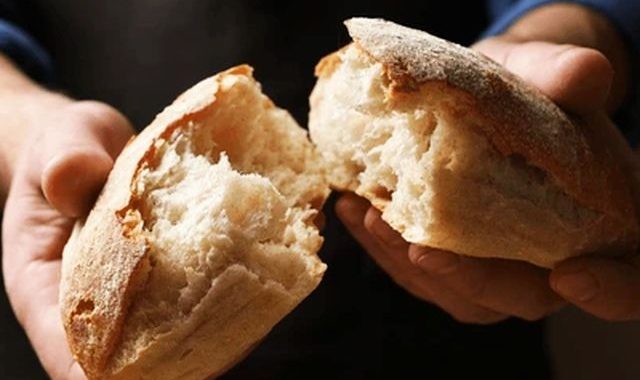
One last thing on a personal note. I often reflect that as I place the broken bread into your hands, it is his brokenness meeting and healing your brokenness; and let’s be honest, we are all broken in some way, somewhere, somehow. Remember it is the piercings, the unlovely, brutal bits that The Risen Master shows off to his disciples. His brokenness is healing the brokenness of their fear and joy.


When we might think that we are useless, we should celebrate our cracks and flaws. They are a unique part of our story and character. Embrace the imperfection and find strength in our scars. Behold, I make all things new. Even you… even me.