Baptism of Our Lord

Baptism of Our Lord 12/1/25

In praise of our excitable God

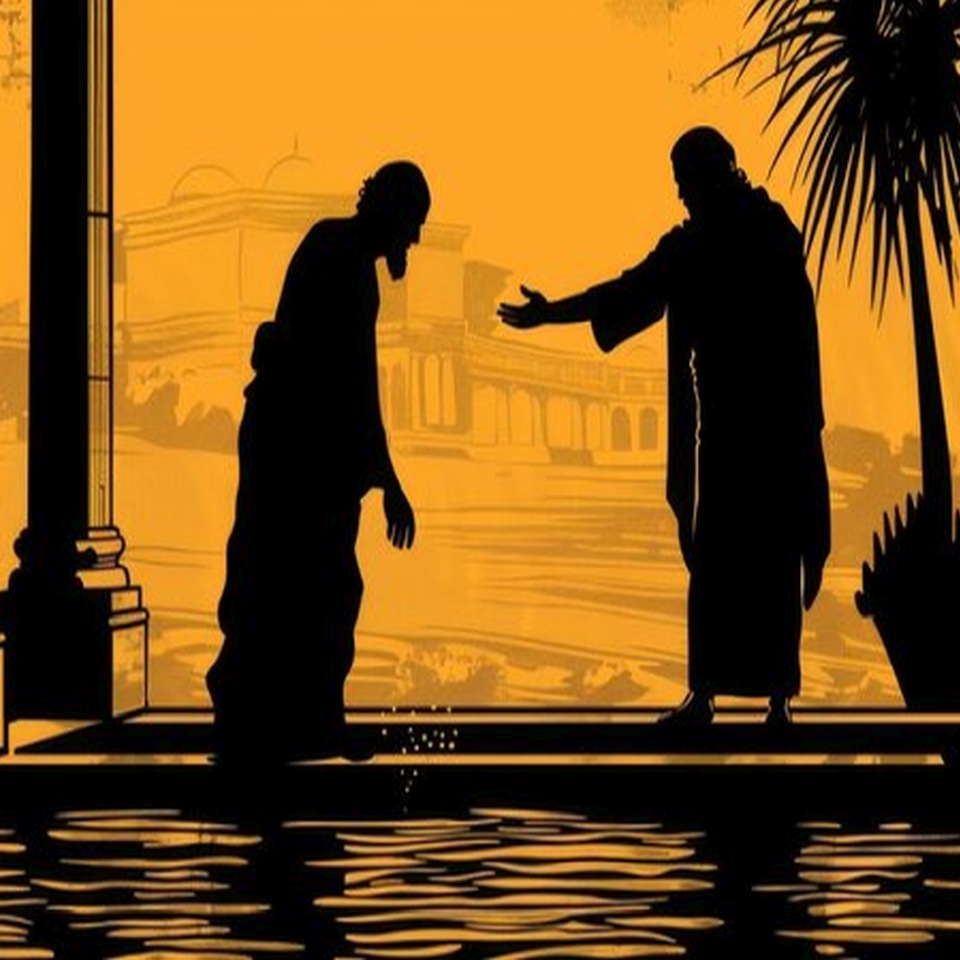
In my mind’s eye I can very easily imagine the scene of today’s gospel. For one thing, those who have been to the river Jordan tell me that it would not pass our stringent O. H. & S standards. The river Jordan is not chlorinated and sparkling clean and you can’t see the bottom. So I envisage something like the muddy farm dam of my childhood, complete with Redfin, mud and yabbies. I love the image of a wild and wooly John the Baptist, complete with an embarrassingly large unkept beard, whilst waving a hefty pastoral staff passionately in the air. On the banks of the River Jordan he is proudly sporting the latest camel’s hair coat and matching leather belt. There he is, loudly hollering and encouraging the folk to get their stuff together. To repent and believe the good news, that sin can be forgiven, that they can be baptised by the Holy Spirit and that the Messiah is coming. He seems undaunted or oblivious to the fact that he is making an enemy of powerful Herod.

In this scene Luke even tells us about the sense of expectancy and wonder that was amongst the people.

“The people were waiting expectantly and were all wondering in their hearts if John might possibly be the Messiah.”

When I conjure up the vision I sense the peoples anticipation and hope. And if I had been there … would I have been caught up in their emotion? I’d like to hope so. But what about us today? Do we still have that flutter of nervous exuberance? And if not, where, when and how, did we lose that sense of anticipation.  It might help to recapture some of this sense of awe, if we remember who it is that is with us today. The seen and the visible, the unseen and the invisible. And it might help if we remember that it isn’t always supposed to be roses and champagne and twinkles in our eyes and butterflies in our tummy and unstoppable grins. We can’t always go on exclaiming ‘Yippee’ and ‘Hoorah’, at the top of our voices. Surely that sort of passionate hoopla and merriment is unsustainable.

Perhaps then, we are more like the mature couple who know and rejoice quietly in the fact that the heady days of their youth have mellowed and matured into something far more deeper and far more lovelier.

Our relationship with the living God has developed through days and nights of being in the murky waters where nothing much seemed to happen and yet everything has happened.

Perhaps in 2025, when we have a few more wrinkles and our hair might be a more silver fox look, we might celebrate the fact that our love of God is no longer a puppy dog rush to get to the altar in glee and gusto, but rather it has become a graceful, gentle striding, maybe even a hobble, towards an old friend who we have come to rely upon, rest in and appreciate more and more, knowing that we have always been his child and we always will be.

So what would happen if instead of feeling guilty about not hurtling to the altar we simply tottered quietly, and enjoyed each and every step. Wouldn't that heighten the desire and the joy of knowing that He is just as excited to be with us as we are to be with Him?

Mmm… Hang on. Now there’s an interesting thought. What if we worship a God who not only loves us, but actually gets excited about us.

I reason thus. That if Jesus walked the dusty streets of Palestine, was dunked in the mawkish waters of the river Jordan, bled real blood on the cross, wept real salty tears at Lazarus’ grave, drank real wine, ate real fish and bread… is it not highly probable that He also got excited and gets excited still. If we are made in the image of God then there must be times when he is not only sad and grumpy, but also delighted and excited and thrilled. If he shares every aspect of our humanity except sin, that must mean that God gets excited. Our God is in fact, not aloof, distant and cool, but a passionate and excitable God. You all probably had this worked out a long time ago, but I’ve only just woken up to this thrilling thought.

And what would walking towards an excitable God mean for us personally when we come to the altar today?


And what would this excitable, exciting, and excited God say to us? Probably the same thing that he said to Jesus his son when he was in the skanky waters of the river Jordan. If you listen carefully you might just hear him say “You are my child whom I love. With you I am well pleased.”

Esse Quam Videri

The difference between doing and being.

Someone once asked me if I had ever done anything else apart from being a priest. The answer is ‘Yes’. I had a very wise bishop who strongly encouraged me to go and get a regular 9 to 5 job so that I might have some sense as to how the secular world ticks and turns.

At 17 years of age, I successfully applied for a job as a tour guide in a winery. It was a marvellous opportunity to learn about the wine industry and it taught me a lot about people. I stayed for 4 years and remember my time fondly.

Then off I toddled to college and now here we are several decades later. My inquirer made an incisive observation, perhaps without realising it, and the observation is this.

That there is a big difference between doing and being. I did the job at the winery but that is not the same as being a priest. A priest is something you are and is not necessarily defined by how a cleric fills their days. There are actually a tiny minimum of things that I am licensed to do that unlicensed folk are not permitted to do. In fact, if you add up the amount of time that I spend doing exclusively 'priesty things’ it’s less than a day a week. Everything else could easily and competently be done with much more alacrity than someone other than me.

And this difference between doing and being, this sense of vocation is not limited to clerical collar-wearing folk. I strongly believe that farmers, medical people and those who work in the funeral industry, (to name but a few) all know the difference between ‘doing’ and ‘being’.  It’s a subtle but important difference and one that I rejoice in everyday.

Esse Quam Videri -is a much used Latin atin motto meaning to be rather than to seem

Epiphany 2025 | Jan 5

Epiphany 2025 - January 5th

The poem I offer this week comes from Scott Bates. It’s cleverly written and takes the vantage point of one of the camels in the Epiphany story.

The Camel tells us about his own search and it’s not the quest we often think of at Epiphany. Usually, we think of the magi, and therefore the camels, searching for the Christ-child. And that’s true and right. They go looking and searching and it's a long and tortuous process, with many missteps, working night shift and a bad guy thrown into the story for good measure.

In Scott's poem, it’s as if the camel glimpses not only the Messiah but also the sense of community and service that the brat in the manger envisions and hopes for all of us. So the poem talks about that invisible commonality, that intangible web of support and nurturing one with another, when we dispense with what we think is important and take up instead a life of service and friendship. The camel discovers that this life is its own lasting treasure of infinite value. Far more precious and enduring than gold, frankincense and myrrh.

And it doesn’t matter where we happen to live, or what we do for a crust. Whether student, retired, pensioner or highflier, our real treasure is discovered in our conversations, relationships and friendships with each other. Love is made manifest in the everyday dishes and weeding and cuppa and silence and thought bubbles. Here in what we think is boring and dull, we discover Christ made flesh in a different, but no less authentic way.

There is an implied criticism in the poem of the kings for not having stuck it out and stayed with the Christ child–that’s why the camel has to slip away– We once were in touch with divinity and then returned to our normal lives. Having savoured and tasted divinity at the cradle the camel becomes addicted and like all of us longs for more, needs more because we have come to understand no matter how dimly and fleetingly, that we have been loved. That we are loved.

In his poem, Scott teaches us about the ebb and flow between secular and sacred. We come along and immerse ourselves in the dimension of the divine and then we scurry back to our everyday lives for what we think of as the secular.  And while I get this and am guilty of it myself, the distinction is in fact false and misleading. Both Heaven and Earth are full of God’s glory. Yes, it is hard to see the divine out there. Outside the church building. But the divine is all around us and within. All of us lose our vision and must rediscover it outside the four walls of our own God box.  And if you’re anything like forgetful old me, this looking and searching and glimpsing the divine is something we do again and again and again.

Scott gives us a couple hints as to where we might find our ‘new’ treasure. He writes…

It was dawn when I came
To this 
strange land

And found this family
Living here
Without a camel
Because 
they were poor

So it is often in the unfamiliar and the unusual that the Master reveals himself. In unremarkable things that are easily overlooked. And it is the unpretentious, those without any sense of self-righteousness or self-entitlement, those who just enjoy being themselves without any ‘dress-ups’, those who are poor, who have most to give us and who teach us most patiently the lessons that are vital.

You’ll probably recognise the Biblical allusion in the final stanza but, in case you don’t, it’s Jesus’ assertion (Matthew 19:24) that “it is easier for a camel to pass through the eye of a needle than for a rich man to enter the kingdom of Heaven.” “Effendi” is Arabic for “Master.” Having ditched the gold, frankincense and myrrh, passing through the eye of the needle and into the new Jerusalem is a giggle and a cinch. What if we are in fact already there, walking the streets of gold with angels and archangels and the whole company of heaven…

By Scott Bates

I went all the way
But on the return trip
I gave the caravan
The slip

One desert night
Quit Balthazar
With all his frankincense
And myrrh

And headed out
Across the sand
It was dawn when I came
To this strange land

And found this family
Living here
Without a camel
Because they were poor

So I stayed with them
Carried their hides
Gave all the kids
Free camel rides

Sat with the baby
Worked with the man
Sang them ballads
Of Ispahan

Carried the water
Pulled the plow
Loved my neighbor
Who was a cow

I like it here
I’m staying with them
As I wanted to stay
In Bethlehem

With that other
Family I knew
Which proves Master
That passing through

The eye of a needle
Is an easier thing
For a camel
Than a king

Making An Investment

Making an Investment.

Have you noticed that some media burbles at this time of year are where to invest your cash? Shares, property, term deposits and superannuation. They usually ask some guru to fill our space with what will be an astute and profitable exercise. One year I will note what they say and 365 days later I’ll see if they were right.

Now while I know that it is prudent and right to be sensible with our limited resources, to get the balance right between enjoying and saving, a gentle look back over 2024 should teach us that there were other things that we invested in, that, while they are not measurable like stocks and bonds they are just as important.

For example, where did I invest my limited resources in time and mental energy? Did I allocate enough to the portfolio of rest and recreation?

Would it be a punishable crime to just slow down, step back and listen to what is going on inside of us? You know the place, where there are no screens to distract and commentators to confuse.

Maybe I invested far too heavily with the currency of fear, anxiety and worry and gave scant attention to rest, snoring and being still. Sound familiar?

As we totter and stumble into 2025 maybe our resolution should not be to do A, B, X and 3.5. In these next 52 weeks, we might actually do less of these or even none. Instead, we might aim for a Big Fat Luscious 0.

This would be a fantastic investment and reap magnificent dividends. Deep down we know that we are not made to go above the speed limit all the time. It’s a rule for your well-being. Not a challenge to exceed.

The Bowl and the Towell

The first thing to reach for is … the  bowl and towel.

Today’s story begins at a dinner party. The Master is there with some of the more snooty, well-to-do, entitled folk. It’s all going swimmingly well with the swilling of expensive wine and canapés that are more designed to be a work of art than a source of nutrition.

Somehow a ‘working girl’ slips the security net and is at The Master’s feet, weeping. To inflame the sense of indignation and inappropriateness, she kisses his feet and wipes them with her hair.  If Jesus only knew what she did for a living…

Fast forward a couple of years and The Master is keeping the Passover with bread and wine and herbs and lamb. Nonchalantly he picks up the bowl and towel and washes his disciple's feet. This is a grungy job, always done by one of the underlings.

When the last foot has been washed and the silence of be-puzzlement has descended upon Jesus’ buddies he will ask them a piercing question. “Do you understand what I have done? This is how you are to behave towards one another.” Whenever you want to know how to treat another, instinctively reach for the bowl and towel. Pick them up and do not put them down. Remember the lass who wiped the feet of the elite? This is to be your modus operandi. Your way of being, your way of living.

While this attitude is true for all people, it is something the ordained clergy should lead with… if that makes sense. Never put down the bowl and towel. They are the foundation of all ministry.

These are the tools of trade that are indispensable and that we must come to love and use more than anything else. The first thing we reach for. It is who we are.

There in the earth of my hands
I saw life itself,
life like silent breath
emerging from the sands of death,
life like a stark red flower
crying amid the white limestone fields,
life like a single blue wren
skating across black granite boulders,
life so precious
the pain of holding it was unbearable.

In that child I saw
the flesh of every child,
warm flesh that bleeds, enfolds,
and quivers at the hope
of being man or woman,
yet true to that same flesh
as sun and wind and Outback dust
toughen skin and soul alike.

This child was my flesh,
my flower, my son,
mine.
I was ready to defy God
and make that child mine
forever mine
against all thieves
who sought to possess him.

Later, in the house of God,
I gave my child back to God
and with my flesh I gave
two birds to celebrate the day,
two birds to fly,
two birds to die
and redeem my child for life.

Mary’s Gift

By Norman Habel

Mary’s Gift

For long months I pondered
my child within me,
the line of its nose,
the turn of its face.

I pondered in pain
how the lurking shadow of God
had shaped form
or deformity within my womb.

Then we were two,
Jesus and I,
facing each other
with shocks of wonder,
touching each other’s eyes
with lingering questions.

He lay in my open palms, so small,
oh so small,
as if the pressure of my fingers
would count as cruelty.

The Wise Women

A Reflection: The Wise Women

Written by +Deon K. Johnson, bishop of the Episcopal Diocese of Missouri.

They came. As they always had. At every birth. The midwives. They came with the ancient wisdom. No fuss. No fanfare. They came as women always have with the insight of attending the most sacred act of birth.

Their presence didn’t even make it into the Good News because this is just what they do. They came with swaddling bands and birthing stools. They did what the ancient mothers have always done. They calmed the frightened mother with the compassion of wisdom. Told her what to do.

They came, those gentle wise women. Not at the summoning of a star but by the cries of labour. With ancient strength and quiet gentleness, they went about their business.

These unsung wise women have always been there. Unseen. Doing the thing that God has called them to be. They follow in the path of Shiphrah and Puah who went before them.

Today, perhaps we need to recapture a bit of the spirit of the wise women, who in their quiet confidence points us to a faith beyond the spotlight, that welcomed the Christ-Child into a world in need.

They came, these wise women, as they always have and as they always will, to bring Divine hope into the world. No greater gift can we give.

So here’s to the wise women. The faithful and fierce women, the practical and passionate women, the compassionate and caring women. We may not always remember that you too came, bearing gifts of precious worth, to attend the Messiah’s birth

Christmass 2024

Christmass 2024

The muck of our mistakes.

It is easy when we know God is born into our good stuff, in our joy and giggling and triumphs. This is where we see Him, feel Him, and delight in the sense of closeness with Him. In these moments we do so easily with clarity and glee. And in these times, in the easy and luscious times, it is right that we celebrate with God and in God.

But what if,… like the squealing urchin in the wonky rough-hewn feed-box, God is also right in smack bang, firmly ensconced, in our awkward embarrassments? Is it not also possible, most highly probable, in fact, a certainty that God also chooses to live in those dark places within us? Those murky areas where we actually don’t want His light to be shone, because we know what is there and we are ashamed. God born in Our humiliating times, our most appalling, abysmal and woeful places. God is born in our most ghastly mistakes.

Surely if he is the incarnate God, a God who comes in human flesh, he is God for every last bit of us, leaving out absolutely nothing. So we offer God the crude, rough, manky and dank places and we ask him to be born there as well. It will take a lot of courage to let Him lie there amongst our denials, our misgivings and our frailties. God is made flesh and is right there with us and in us, in those times when we chose wrong, knowing it was wrong,  but we chose it anyway because it felt right, it seemed like a good idea at the time and who will ever know nudge-nudge? The Christ child was and is with us when the wrong action presented itself and we winked, we flirted, we succumbed. We went over to the dark side. Those times when we allowed the wrong harsh words to escape and found to our appalling horror we could not put them back in our mouths. The arrow thoughts about … well … you know who.

Mary and Joseph’s long, dark, painful journey is a symbol of our soul searching where we stumble, and tumble along the rocky path of conscience and self-examination. Like Mary and Joseph, the trek is uncomfortable and disquieting and we might well think… how did it ever come to this? What am I doing here?

But at the end of the trek, when we arrive at our own Bethlehem and are candid about our raw, naked, slime, sludge and mire, we will discover that the Christ-child is already there on the straw sleeping comfortably knowing that this is where He wants to be. We worship a God who wants to be right there in the slush of our murkiness. And He actually wants to be there, longs be there can be in no other place than right there because of His unrelenting, unremitting, unquenchable, uncontrollable, uncontainable love.

So my prayer for us this Christmass is that not only will we discover God in the champagne and the tinsel and the family and the sweetmeats and the presents. But that you and I will also have the courage to discover with amazement, delight and surprise, that He is also right there in the muck of our mistakes. Squealing and gurgling with delight. And there with our own beasts of guilt, hand wringing and regret, we will discover that we are not as alone as we first thought. That Our Lady and St. Joseph and shepherds and angels are right here with us. They are welcoming us and cheering us on and are our very best friends. Ever.

It took us a little while, maybe a whole lifetime perhaps to understand this simple but profound fact. That there is no stable, no error of judgment, no place of denial, no act of betrayal, no oversight or blunder where God cannot be.

It has taken us far too long to know this, and now that we do, it is something we should celebrate for a long time indeed for the rest of our lives. This saving fact should send corks flying to the ceiling and fill our mouths with laughter.

Until that day when we no longer need the tinsel and the piped music and the bonbons and the bread and wine.

God came from heaven to earth; so that we on earth might … forever and ever amen.

Advent 4

Advent 4

Who will make him welcome…??

This homily completes our advent series where we have been reflecting on some of our most popular christmass carols.

A good Christmass carol, or any hymn for that matter, should not only be a joy to sing, should not just teach us something, but it will also challenge us to think and act differently.

Today’s hymn is the classic ‘Long ago prophets knew’. By the marvels of modern technology and because it’s the 21st century and we can do anything and everything here, except cure the common cold, achieve world peace… Oh and stop nasty potholes from appearing in the roads … The words to this splendid hymn appear in the pew sheet for you. If you are reading this online then this might work . https://hymnary.org/hymn/NEH1985/10

The carol tells the Christmass story leading up to the time Mary and Joseph arrive at Bethlehem.

Verse one is all about the prophets of long ago who foretold the birth of the Saviour. These people knew that the

“Christ would come, born a Jew,
That he would come to make all things new;
That he would bear his people’s burden,
and that he would freely love and pardon”.

Verse two tries to explain the mystery of God made flesh, well, as much as anyone can.

God enters into our time, on a specific day and in a specific place. The Christ child who is God, becomes touchable, measurable, and holdable. He is born of a woman. God is divinely human.

Verse three tells us more about this woman who is pivotal and essential to God’s plan. The hymn gives us her name, guesses at how she might have felt, and that she believed and obeyed.

Mary, hail! Though afraid, she believed, she obeyed

And then there is a mind warping line that should both challenge and excite us.

In her womb, God is laid.

Just sit with that and think about it. …

In her womb God is laid.

Mother Mary had God in her womb. What does it say about her, for God could have chosen anyone?

And what does it say about the crazy, outrageous risk God took?

Verse 4 tells us that Mary and Joseph finally make it to Bethlehem and the stable door is open waiting for them.

Journey ends! Where afar
Bethlem shines, like a star,
stable door stands ajar.

So we have the prelude of the Christmass story told to us in the verses.

But there is also something very important going on with the Chorus of this hymn.

The first three times the chorus is sung it asks  a very pertinent question

When he comes,
who will make him welcome?

But on the last verse, the chorus changes and it’s really easy to spot the difference.

Jesus comes!
We will make him welcome.

So the hymn is about the two comings of Christ. The first was at Bethlehem in a stable where Mary, Joseph, some aromatic animals and shepherds welcomed him.

The 2nd coming of Christ is at the end of time when he comes to wrap up everything and make all things tidy. And we will welcome him.

But there is something going on between these two comings of Christ, here in 2024.

Every day we have an opportunity to welcome him.

The stable door of our hearts and lives must be ajar to all who come knocking, looking for hope, acceptance, love and reconciliation.

When I was writing this I thought of some of the characters that made Jesus welcome when He walked the dusty plains of Palestine.

The thankful leper, the prodigal son, the waiters at the wedding at Cana, the tax collectors and the prostitutes, the blind man yelling out on the roadside for mercy, the woman caught in adultery and the centurion, to name but a few.

The poor in spirit, those who mourn, the meek, those who hunger and thirst for righteousness, the merciful, the pure in heart and the peacemakers. These are the people who welcome Christ because they welcome all.

I also think of those who did not make him welcome, like the clergy of the day and there is a Christmass warning for every cleric.

Who will make him welcome? We will, but before we can welcome him we first have to be able to see him. Where to look?

The trick I think is to begin by seeing him within our own selves first. To rejoice and whoop with delight that just as God chose a very grungy place to be born the first time around, we understand that there is no place where God cannot be. Even in our own hearts and lives. And when he is born in us; when we see that and understand that, it’s not so hard to see God in those around us.

His first arrival was largely hidden from the world. He came at night, to a one-hick village, where there was no printing press, internet or social media, yet the word was made flesh and the message spread.

We will see him in the shabby, and the broken, and those who think differently to us. He appears in the most unlikely of people and in the most grubby and fragile of places.

Like bread and wine, like you and I.

When He comes, He has come, He will come and we will make him welcome.

It was a heck of a risk

It began by sending out the invitation to a single teenage lass who lived in a quiet little Hamlet where the services were being withdrawn and the community forgotten.

She could have said a polite ‘No thanks; this seems like a scam’. Actually, she was kind of right. While the deal was authentic, it cost her everything. Once she had said yes, there was no going back to the simple, quiet, life of anonymity.

But the risk was even more daring, more scandalous, more outrageous than she could ever have imagined. To send the Son, the heir, to the place where the slur was ‘can anything good come from Bethlehem’ was not the most astute business move. But it was because it was bold, brash, daring, audacious and unthinkable that made it all the more appealing to those who were looked down from the lofty heights of entitlement.

Whenever a gift is handed over to someone else there is always a risk. What will the recipient do with it? Re-gift it in 12 months time? Treasure it, rejoice in it, use it, put it at the back of the wardrobe or in the recycle bin? Stomp on it, crush it, discard it the moment it becomes a nuisance and does not follow the prescribed instruction manual.

A gift is a vulnerable thing, a priceless, risky thing especially when it is given with more love than we can ever comprehend. When the giver has invested everything. When the Giver gives their very self. It’s a heck of a risk.

What happens if… the world spins merrily, giddily on its way, oblivious to the offer? Was the giver reluctant, to have second thoughts? Will it be worth it? Will it all pay off? Only you, dear reader know.

The Challenge of a Silent Night

The Challenge of a Silent Night.

Here we are on the cusp of another Christmass. At this time of year it’s easy to be diagnosed  with the disease ‘sensory overload.’

This is a highly infectious disease and passes quickly from one to another, especially in congested areas like supermarkets and dining establishments. There is no immunisation against this debilitating malaise and only enforced isolation, space and the turning off of all screens, can temporarily relieve the symptoms.

The carol ‘Silent night’ would be a script for the medicine we so desperately need at this time.  The call to silence and peace is easy to write about, hard to hear and well nigh on impossible to put into practice.

To stop. Just stop! And focus on the maiden, manger and child. To think about nothing else … nothing at all, is an exercise for the wise and the courageous.

This is my 64th Christmass and I would have hoped for the bombs to have stopped falling, political rhetoric to be quietened  and the calming vocabulary of silence to blanket us. To speak of peace on earth and good will to everyone. Why can’t we achieve this? But then a quick look at my own frenzied activity, the rubber tyres and barbed wire of doubt and edginess in my heart, the speed with which I think that if only old so and so would…

Silent night must start deep within me. The wise old carol calls me back to a higher ideal and the imperative to persistently keep on trying.


May you make the time, space to have a silent night. Instead of the discarded wrapping paper and the credit card debt, may you see what the shepherds saw. Angels and the fresh hope for all people, asleep on the hay.

Advent 3

Advent 3

What child is this? …What child indeed?

We are reflecting on the words of some of our Advent and Christmass hymns this Advent. We sing them lustily and so frequently that we can easily forget that the words have something to teach us.  The best hymns make us think a lot.

Today I want to unpack some of the words of that classic carol “What child is this?” I’ve put the words in the pew sheet so you can see the clever way the hymn is constructed. It comes to us in a question-and-answer format.

So who wrote this masterpiece?

A gentleman by the name of William Chatterton Dix in 1865 when he was just 29 years old. It was during this time that he suffered a near-fatal bout of sickness with depression. If you like, he very nearly died.

It was in this very dark time that he actually experienced a spiritual awakening that inspired him to start crafting hymns. A better-known hymn that He also wrote is ‘As with gladness men of old.’

The hymn itself speaks to us about the visit of the Shepherds during the birth of Jesus. The lyrics are structured around a series of questions and answers, with the questions reflecting what the shepherds might have been asking when they encountered The Master in the Manger. The hymn's melody is often described as "soulful" and “haunting" and it is that ever popular tune “Greensleeves”

This hymn gives us the feeling that God himself has through this baby, transformed into humanity and that the Almighty has arrived to rescue us. For the shepherds, it's a certain and clear sign, which they went on to declare with courage and fervour.

The skanky shepherds go from the marvellousness of the angels, expecting to see a glorious king and instead, they are shown the back of the local and into a dark cave. Is it any wonder then that William Dix places on their hearts and lips the first question?

What Child is this, who laid to rest,
On Mary’s lap is sleeping?
Whom angels greet with anthems sweet,

But more than that, do you see the clever way William has already drawn us into the drama so that we too, as we sing the words, are asking ourselves and therefore each other the same question.

What child is this?

And there is an undercurrent, a hidden but almost palpable sense of…

‘This is not what we were expecting. This is not the sort of king we had envisioned. This is not what we had hoped for and could we please have our money back. Having left our precious herds on the hill we were kinda hoping for something a little more… weren’t we?

The answer
The answer to the shepherd’s question and therefore our question is given to us in the chorus  “This, this is Christ the King”.

And in verse two the concept of a God for all people is comfortingly reinforced.

Why lies He in such mean estate,
Where ox and lamb are feeding?
Good Christian, fear: for sinners here
The silent Word is pleading.

We are taught that what the shepherds see before them is a child for all levels of humanity.

When we read the hymn through and look thoughtfully at the words, we discover that it tells both a story and a mystery, which is of course everyone’s life. A story and a mystery.

And that is one of the reasons Christmas is such a poignant holy day for all, young and old alike. Christmas is both a story and a mystery.

What does it mean when we say that each human life is a mystery? It means there is a truth about each life that is deeper than anything any person can see. It is true that something of it can be seen from the outside, as an individual’s life story unfolds. Over the course of a year, ten years, or a whole lifetime, more and more of that deep truth breaks through. The story of a person’s life tells us a lot about who they are, why they are here, and where they are headed. This is their story.

The mystery part always remains hidden. The part that we can never quite understand. Sometimes we tantalisingly glimpse it, but such occasions are always fleeting. We can never analyse it, interpret it. At best these glimpses are fragmentary. Like the Master at table at Emmaus with the two disciples. Little snatches of the divine. Glinting, Mysterious. We sort of get it and yet we can never grasp it fully and tidy it away.

This mystery is what I believe our hymn writer William draws us into. By inviting us to sing with our lips and our lives ‘What child is this?’ he has already immersed us into the muck and the mystery of the manger. We are there with the angels, the shepherds, the animals, with St. Joseph, with Our Lady.

So again, in 2024 we ask ourselves ‘What child is this?’.  What child indeed?

Hark: Sit up, Take notice. Listen!

Advent 2 December 8th.

Hark:  Sit up, Take notice. Listen!

During this Advent, we’ll be reflecting on the words of some of our Advent and Christmass hymns. We sing them lustily and so frequently that we can easily forget that the words have something to teach us.  The best hymns make us think a little.. or a lot.

Today I want to unpack some of the words of that classic carol ‘Hark the herald angels sing’.

The very first word tells us what we should be doing this Advent.

Hark.

This little word means Sit up, Take notice. Listen!

And as angels are God’s messengers, this hymn is in fact a type of angel. It is bringing us good news.

The hymn or perhaps the author, has something to teach us. There is some important knowledge to impart. Something that is really newsworthy, in fact something that has not been off the news cycle for the last 2000 years. It is The good news of the birth of our saviour.

Hark. Sit up, take notice. Listen!

The hymn will teach us and encourage us to become apeople of reconciliation. Reconciliation with each other and reconciliation with God. So we get …

“Peace on earth, and mercy mild,
God and sinners reconciled.”

One of our greatest needs for 2025 and beyond is reconciliation. As I write, wars rage across this planet; tribe against tribe and nation against nation. But more subtle than that, I am very much aware of those who espouse an ‘Us versus them’ policy. ‘Those over there’ are not ‘us’ and therefore they are somehow less than us. They are not worthy or entitled to the privileges that we take for granted; they are not welcome. In God’s eyes however, all are equal. The prodigal son, the taxi collector and the prostitute get into the kingdom of heaven to feast and dance ahead of the clergy Fr. David!

This is how another great hymn writer put it.

Lord in your good creation
All people, every nation
Bear a dignity and grace
Images of you

So help us treat all others
As sisters and as brothers
Valuing all you have made
As good and as true.

The peace of which these words speak goes far deeper than simply a cessation of conflict between warring factions. It reveals the peace in which you and I can enjoy our Creator. This peace is enduring, everlasting even, and life-changing.

It is when we see that God is in the messiness of retribution and retaliation, when we understand that He always wants to be with us in our muck, then we can be at peace with Him, within ourselves and with each other.

Next, The Carol speaks to us about Revelation. Hark. Sit up, take notice. Listen! God has revealed himself to us.

“Veiled in flesh the Godhead see!
Hail the incarnate deity!

The baby born in the ick of the cave gives us a glimpse of the Divine. When we reflect on the reality of that first nativity scene, we realise that the God on the mouldy straw is not what we would expect or hope for. God in a cold, dark place. Snuffling smelly animals, a virgin giving birth and vagabond shepherds who haven’t quite managed to shower for a couple of days. Maybe a little merry from a night warmer or two. The weeing, defecating brat in the manger is actually ….God. God in the flesh, the incarnate deity.

God came down to us in the Person of the Lord Jesus Christ. He fully shared our humanity and knows all about the kinds of trials and tribulations we experience today. How amazing that He entered our world of pain in order to make an entirely different quality of life available to those who receive Him.

Hark. Sit up, take notice. Listen!

The Carol tells us about Righteousness and Resurrection

“Hail, the heaven-born Prince of Peace!
Hail, the Sun of Righteousness!
Light and life to all he brings,
Risen with healing in his wings

‘Sun of Righteousness’ is a title given to the Messiah (Christ) by the prophet Malachi. Four hundred or so years before the birth of Christ, Malachi predicted that God’s sent One would: “arise with healing in His wings” (Malachi 4:2). Wesley, the author of the hymn, applies this to Christ’s resurrection (“Risen with healing in His wings”).

So we get

Mild he (God) lays his glory by
Born that we no more may die
Born to raise us from the earth (or ‘our grave’ if you like)
Born to give us (a) second birth.

So we have our first birth in the labour ward and our second birth is when we enter heaven.

This Christmas, enjoy singing the carol. In fact, enjoy singing every carol. But when you are singing the words try to remember Revelation, Righteousness, Resurrection & Reconciliation.

Isaiah had it right.

See, I am doing a new thing! Now it springs up; do you not perceive it? I am making a way in the wilderness and streams in the wasteland.

Hark! Sit up, take notice. Listen!