The Marvellous Ministry of Myf

The Marvellous Ministry of Myf

Some of you may be aware that my daughter, Jacky, and her husband, David, have a corgi named Myf. Like all pets, Myf has a marvellous, subtle, almost indiscernible ministry.

Part of Myf’s ministry is that she selflessly takes the blame for other people's unsociable noises and odours. You know this has happened when someone exclaims ‘Myf!’ with a false sense of horror and surprise, and it’s really quite obvious that Myf is not to blame at all; but then how can a growing Corgi defend herself against such lurid accusations?

Outwardly at least, Myf doesn’t seem actually to do a lot. She takes Jacky and David for lovely walks in Central Park. She eats food that no other human being desires, and sometimes goes to doggy day care for a social day out. On some of her walks, she has learnt that the owners of particular shops will offer her treats and put out bowls of water for her to drink from. This is all very charming and cute, but perhaps one of the most important things that Myf has done and continues to do, maybe without knowing it herself, is to make encounters possible with people she has never met before.

What happens when the three of them are strolling through lovely Central Park is that Myf will unabashedly approach other dogs and their owners just to say ‘Hello’. With other dogs, there is often some sniffing going on, just like we would shake hands. People stop, ask if they can pat Myf, and engage in conversation. What is your corgi called? How old is she? How long have you had her, and so it goes on?

Often, at a particular place, at a particular time, on a particular day, various dog owners gather so that their canine pets can play together. More chatter, more laughter, relationships are started, strengthened and enhanced. And when you are in a new city, in a new country, an adorable Myf is just what is needed to help you get to know a few people who have a common interest.

You see what a gift Myf has been, continues to be and will be into the future? Apart from barking at human noises in the hall, Myf has effortlessly helped to integrate David and Jacky into a community of people they would never have met.

Myf has also taught her proud owners the privilege and responsibility of caring for someone other than themselves. Often this is not easy and there is a sacrifice to be made. Like the ‘nature calls’ and illness in the middle of the night. The worry when Myf gets sick, is off her food, or is just down right belligerently disobedient and will not move unless she is physically picked up and carried. It’s been quite a journey for Jacky and David, and they continue to carry out their ownership duties with love, aplomb and joy.

Myf, for her part, as far as we can tell, has done all this whilst just lolling about, being fed with treats and occasionally getting grumpy with the vacuum cleaner. How do you get a voluptuous life like that?

Now,… and this is the really good bit. Is it not possible and probable that, without our realising it, we too have made encounters possible with other people? This happens frequently, and it is not until sometime later that we realise that something quite beautiful has blossomed from something we had completely forgotten about. So unremarkable was that event, that conversation, that we didn’t bother to deposit it into our memory bank. It was just another day, another frivolous piece of chatter. But something happened, something was happening, and we enabled it to happen. While we walked blithely on, a seed had been planted, and things have changed.

But it does come with a note of caution. That just as our words and actions can bring about great harmony and friendships, you will be painfully aware that sometimes, without our realising it, we can also have a negative impact and God’s plans can be thwarted.

So if God can use a humble, lovable and quite cute corgi, one who lives in Manhattan and has the curious name Myf, a dog who has no grasp on the English language, has never gone to school or studied theology, then he can use and I to reflect some of his unconditional love to world that aches for his forgiveness and peace.

Myf’s marvellous ministry is not just to those on the other side of the planet but also as an inspiration for us in our everyday life.


Want More Faith?

Want more faith? First, put on your apron.

When you initially read over today’s gospel, it appears as though we have two quite distinct and different pieces of literature.

First, the disciples come asking for their Faith to be increased. It seems a perfectly logical and commendable question. If only everyone would ask for their faith to be increased, then the Church of God would be sorted out, world peace would settle upon the planet, and the housing crisis would be a thing of the past.

You would think that, being the wise and compassionate, supportive, and encouraging Messiah that Jesus is, he would give his disciples an easy three-step programme, one that anybody can do at home, for all to complete in the comfort of their lounge room.

But No. Instead, they get a verbal rebuke.

“If you had faith as a grain of mustard seed, you could say to this sycamine tree, ‘Be rooted up, and be planted in the sea,’ and it would obey you.”

Clearly, chaps, you’ve got a way to go.

And what follows seems a completely unrelated story altogether. Clearly, a dotty old monk, working late at night by a fluttering candlelight, has missed out a connecting paragraph, and we are left with a disjointed and puzzling piece of text.

In classic Jesus style, he answers the disciples' question with his own question.

“Will any one of you, who has a servant ploughing or keeping sheep, say to him when he has come in from the field, ‘Come at once and sit down at the table’?  Will he not rather say to him, ‘Prepare supper for me, and gird yourself and serve me, till I eat and drink; and afterwards you shall eat and drink’?  Does he thank the servant because he did what was commanded? So you also, when you have done all that is commanded you, say, ‘We are unworthy servants; we have only done what was our duty’

It took me far too long to see it, but I do believe there is a connection between the two.

If you want more faith, gentleman… very well, this is what it will involve.

After you have had a hard day in your day-to-day grind of life, the important work of serving others begins. Gird yourself, put on your apron, peel the spuds, lay the table, pour the wine, scrub the pots and pans, do the dishes, clear away, wipe the benches and put out the breakfast things for tomorrow.  Do all of this without seeking any reward, any thanks, no pat on the back or gold stars, except that you know you were doing what was expected of you. It is not just about doing, but it is the attitude with which you do it. Understand that it's not about you. It was never about you, and if you want to increase your faith, really want to increase it, then you dive headfirst into the mundane and the dreary. Increase your faith by embracing your failures and rejections. You will discover that sometimes the most effective prayer is that which feels most ineffective and futile. Or as another really super priest once put it. “He is most intimately present when he seems most bitterly absent.”

You see, part of the fallacy of the disciples’ request is that they expect the master just to dollop out faith as easily as chicken pie. Expecting God to do our faithfulness for us is like a slave expecting to be waited on by his master. I’m terribly sorry to say that attaining more faith does not, in my experience, work like that. More faith and growth in faith is our responsibility. It is hard won, over a stupidly long period of time. It is manufactured and stirred around deep within us with: tears as well as laughter - dreariness as well as excitement - boredom as well as exhilaration. And for some reason, growth in faith is easier to see in others rather than see it in ourselves, and if someone could explain why that is so, boy, I’d really love to hear from you.

Faith is gradually infused into us when we simply rock up, put on our apron, maybe even a pair of rubber gloves, do our work, say our prayers, shed our tears and giggle uncontrollably. We will increase our faith when we sob with those who ask the bitter, hard questions. The ones that only have a cement pylon of silence for an answer. We increase our faith when we incessantly love the grumpy and irritating people into heaven.

It is in the daily grist of simply doing our work that we discover, to our delight, amazement and surprise, that actually, we have come a long way over the past few decades, and our faith has actually increased not because we got a kilo in a quick business transaction, but our faith has increased because of our bruises and skinned knees. Something happened, was happening, is happening at the altar rail Sunday by Sunday. It happened to the bread and wine, it happened in those around us, and it happened to you, and goodness gracious, it even happened to that crazy Fr. David.

So while on the surface of it the two chunks of today’s gospel seem completely unrelated, they are in fact a single unified question and answer session.

Expecting God to do our faithfulness for us is like a slave expecting to be waited on by his master.

Want to increase your faith?

Sure, this is how.

‘Put on your apron, prepare supper for me, and serve me; 

Lets Make a Splash!?

Let’s make a splash

Today’s reflection was handed to me on a silver platter by a year 10 student long ago and far away.

She said something like, ‘You know Fr. Oulton, I really like the way that we can splash about with crazy ideas in your class. We learn just as much from the discussion as we do from some crummy old textbook.’

Splashing about in the waters of ideas is a splendid pastime. Often, we try really hard to come up with a well-reasoned, logical answer that is always right. It works well in the maths world. But (un)fortunately, it's not just a maths world.

It's also a messy, murky, shifting, always evolving world. The answer is not easily found and is often illusory and inadequate for your problem.

So what if, in all our angst, frustration and solution-driven mentality, we simply stopped shouting, lowered our blood pressure and just splashed around in some alluring concepts for a while.

Those who go the hard road, yelling into the air and pumping their fist in the hunt for common sense and decent answers, might try slipping into a trendy pair of flamboyant bathers and just sploshing about in the water. Do some sprinkling and tossing with others. True, we’ll get a little damp, but the answers we are looking for are not to be discovered in numerals and theorems, placards and shouting. Our answers are in the action, playfulness, chortling, yippees and surprises.

Often, I thought I was just messing about with the ideas and proposals, getting drenched with others and getting saturated myself, only to learn that actually there was one other in the water with us. He is the most vigorous in his frolicking, loudest in laughter, the most sopping in water content, and I couldn’t wait to make a splash.

Who is Mr Nobody?

28/9/25

Who is Mr Nobody?

Over the last three Sundays, we’ve had three stories, all exclusive to Luke and all talking about the misuse of cash.

On the 14th of September, we had the parable of the lost coin. Last week, we had the dodgy steward who got caught with his hand in the till and set about to win friends and influence people. In today’s gospel, we have a very clear contrast between the guy who has a truckload of cash and the beggar who has nothing. Clearly, Luke sees our hard-earned currency as an integral part of who we are and what the Christian life is all about.

Luke is at pains to point out the whopping and stonkingly sized discrepancy between the poor man in the gutter and the rich man. Purple clothes in Luke's day were the Prada and Gucci of today. Purple dye was expensive to get, so if you dressed in purple as our good friend in the story does, then you knew that you had made it. You were in.

But there is a quirk in this story that I learnt only this year in 2025. The poor man’s name is Lazarus. He is a specific, quantifiable knowable person for Jesus. His name, “Lazarus,” is very appropriate, for it means “God has helped.”

But there is a prize of a cherry ripe bar to anyone who can tell me the name of the rich guy in today’s story. His  name … is … well… he doesn’t get a name. He’s Mr Nobody. What is Luke trying to tell us here?

Here’s my guess. That in his repetitive and belligerent disregard for Lazarus and all the poor at his gate, the rich man becomes an anonymous, unknown Mr. nobody. His character and that which should make him who he truly is are diminished. Ultimately, he disappears in the mirage of ostentatious self-entitlement. I should hasten to add that His failing is not being wealthy.  It’s not a sin to have a boatload of cash. The question is what you do with it. The flaw in Mr Nobody is that he consistently, consciously chooses not to share his wealth. The spot on his soul is his blind spot to the impoverishment that is on his doorstep. And the real tragedy is that he not only fails to see the poor man and what he might become, but in his lack of vision, his own potential is unfulfilled. He would flourish if he became generous and actually enhanced someone else's life, instead of pushing out his own girth. Thus, he is visionless to his own self-worth. He not only lets the poor man down but, more poignantly, lets himself down. This is why Luke does not give our entrepreneur a name. The guy in the purple Gucci shirt has become a nobody.

And so the trick is that the rich man in the purple shirt is actually poor, and Lazarus gets his name in print for all eternity, to say nothing of his comfy place in Abraham’s bosom in heaven.

This dynamic is not only true of the relationships and people we don’t know, but also the people and relationships that we do know.

We must always say no to the relationships that exclude. Our relationships can be suffocated through indifference, neglect and unwillingness to engage. It is not the cutoff who become nameless and anonymous, it is us because we diminish ourselves and cut ourselves off from the potential that the Master offers.  With his pierced hands, the wounded, the neglected, the lonely and the hungry, God offers us continuous opportunities to become wealthy.

In 604, a gentleman called Gregory gave us this insight.

“When we give to the poor what is essential for them, we are not doing them a personal favour, but rather restoring to them what was always rightfully theirs. More than an act of charity, we are fulfilling a duty of justice”

We do the right thing because it is the right thing, not just to make the other person feel better, or to make ourselves feel all yummy inside, but because it is what the Master asks of us, and that is enough.

It is something we can choose today and every day along our journey. If we can see or sense his living presence in the fragile, broken bread and outpoured wine, it should be an easy step to see him clearly in the fragile and broken in our community.

We choose this journey of selflessness. And sometimes it will seem smooth and dandy, and sometimes it will seem nothing less than just plain hard work. We will rub shoulders and encounter the unglamorous and those who have never made any sense to us. But if we persist and look afresh upon the face of the unlovely, one day we will arrive.

And we will know we have arrived when we confront our insecurities, when we are challenged by that which seems uncomfortable and disagreeable. When we gaze upon those whose wounds are licked by dogs and who are on our doorstep… those who will sleep rough and cold and hungry whilst we feast sumptuously.

‘Go and learn what this means, ’ said Jesus.

‘What I desire is mercy, not sacrifice.’ Become a somebody. Not a nobody.

Parents | The Final Frontier

23/9/25

Parents - The final frontier

It’s an odd but unfightable phenomenon,  but I am finding that more and more childhood memories surface in my conscious memory. They just sort of pop up unbidden and flaunt themselves.

These memories teach me a bit about myself and a bit about my parents. They always leave me with the unquestionable fact that I was loved and my folks did genuinely try to do the right thing. For example, I vividly recall the time I got caught playing with matches and the appropriate punishment was meted out swiftly and with understandable vigour.

But no matter how many memories come up to the surface to say ‘Howdy’, I can only go so far in my understanding. I could never and probably will never understand my Mum and Dad as an equal adult. The years and circumstances did not allow that. So I can never completely understand what drove them, their joys and giggles, their hurts and tears. I can never completely grasp what made them tick.

So while I am continuously learning about all sorts of other people and enjoy the experience, this luxury of getting to know my parents is not afforded to me, which is odd because these are the people who helped to form me.

They will always be vital and fundamental, yet frustratingly ethereal and a marvellous mystery.

I shall look forward to more little memories appearing as each one will take me further and further into the infinite space of my past and, in a sense, my parents' past.

This final frontier I am learning is not something to be feared or approached with trepidation, but a whole new world that in my dotage, is just beginning to open up for me. Something else my parents are still generously giving to me.

The Jig Is Up?

Are You Ready … Because The Jig Is Up?

First up, a bit of context. Luke is the only one to tell us today's parable. He will place it between two other parables that are also unique to him.

Just before today’s gospel, we have the story of the prodigal son. And following on from today’s parable, we have the tale of the rich man and Lazarus. You see, Luke’s got a bit of a theme happening here.

In the parable of the prodigal son, we have the wayward son who squanders his dad's living in seedy nightclubs and on slow horses. In today’s parable, we have the dishonest steward who squanders his master’s share portfolio, while the parable of the rich man and Lazarus begins with ‘There was once a rich man who used to feast sumptuously and dress in fine purple’.

When we come on a Sunday, we usually get just one gospel story, and we can easily forget that the one we hear is linked with others in a theme. We only get the ham in the sandwich.

Today’s story revolves around a rich man who calls his steward to account for poor management of his estate.

Faced with losing his position, yet unwilling to make a living as a labourer or through begging, the steward decides instead to summon his master's debtors one by one. After asking each of them what they owed, he then acquits a large portion of their debts to ingratiate himself towards them ahead of his impending dismissal.

Then comes the confusing part. The steward now has a track record of undermining his master's financial interests. But when the master discovers everything that has taken place, rather than becoming angry at the steward, he praises him instead:

The master commended the dishonest steward for his prudence; for the sons of this world are wiser in their own generation than the sons of light. And I tell you, make friends for yourselves by means of unrighteous mammon, so that when it fails, they may receive you into the eternal habitations. (Lk 16:8-9)

What's going on here? The conclusion of the parable is startling, but that shouldn't come as a surprise. The Master has a disquieting habit of telling us a shocking story to grab our attention and shake us out of our complacency. With that in mind, several things can be said about the interpretation of the passage.

To begin with, we should notice that the master praises the unjust steward not for his dishonesty but for his prudence. Indeed, Jesus goes out of His way to clarify that those who are dishonest in small things will be dishonest in great things (v. 10), and He directly cautions against those who serve the almighty dollar instead of  Almighty God (v. 13). Clearly, then, the steward in question is not being held up as a good guy to be imitated; he may in fact be in grave spiritual danger.

Nevertheless, while the moral conduct of the steward leaves something to be desired, the urgency with which he faces his predicament is admirable. So, as this unjust steward is willing to go to extreme lengths to save his livelihood, how much more so should you and I be willing to go to extreme lengths to put things right.

The dishonest steward is, in some ways, honest in that he is well aware of his limitations. “I’m not strong enough to dig, and I’m ashamed to beg”.

Something is refreshing in the honesty of those who know their limitations. Knowing your gifts, what you are good at and what you enjoy, is the easy bit. It's often harder to fess up and say I have never been any good with left-handed screw drivers and applying striped paint, and I must never pick up a chainsaw… like ever.

What is more, Frank (I’m sure I read once that the dishonest steward was Frank, because he is Frank about his situation)

Frank knows that he is in a crisis, and he never tries to pretend otherwise. As redundancy draws ever closer, she will not be right at all. Things need to be done, put in place, so that when he does have to front up to Centrelink, he at least has some friends who will feed him and maybe give him a bed for the night.

There is a call for us here. A vocation for us to take our spiritual shortcomings seriously and to actually do something about them. We need to be ready, and we need to be honest. The jig is up. All of us have a limited time on this side of the grave. Each day must count, every relationship must be enhanced and enjoyed, every conversation matters, and how we use our fleeting finances is an indispensable part of how we are to live in this life and how we will be judged. We are only stewards for a little while, and like the dishonest steward, sometimes painful sacrifices need to be made. Our stuff was and is, never really completely, totally, forever and ever, ours anyway.

Our real, lasting, authentic riches, like our real, lasting and authentic home is not on this side of the grave.  So… Are you ready? Because the jig is up and we need to start practising for heaven.

Going Cheap

Going Cheap

I am like many of you who have watched that elusive gift of peace disappear further and further into the future. In my little life, I had hoped that we might actually have managed to achieve some semblance of stability. The sort that we enjoy here in Australia. That we might spread it around and help towards a healthy ceasefire or at least some helpful negotiations that might make way for a cessation of hostilities, the return of hostages, the just and equitable sharing of our generous resources.

But it is not so. We need to be honest about that. ‘Us vs. them’ is still the order of the day. The images in our lounge are graphic and instant, and this, I think, only feeds my disappointment. When did my appetite for fear and anger become so ravenous? Have life and property always been so expendable? A quick flick through the pages of any history book will say ‘Yes’. It’s always been this way. But we know better now… don’t we…??

Part of the quandary is that we have heavily discounted the value of human life. It is inexpensive and plentiful. The light of the Christmass story that is peeking over the horizon once more should remind us that all human life is sacred and the skanky pub is the place where God lives. Our church has plenty to say and loudly about how the squashing of another’s life is not acceptable. Thou shalt do no murder is one of our top 10 biggies.

From my desk and through my eyes, all life is of infinite value. To be cherished, enhanced and enjoyed. I deeply appreciate the pull of retribution and revenge, but… it is time. We’ve tried an ‘eye for an eye’, ‘brother for a brother’. We’re tired and it's time to do things differently.

That Silver Coin

14 September 2025

That Silver Coin.

One of the things that made our Lord’s teaching so attractive was that he often dressed up his message in stories. We still tell them, and they still resonate strongly with us.

I strongly suspect that his parables came from real-life incidents that he had personally witnessed. The prodigal son, the good Samaritan —perhaps the Master had seen and experienced families and people just like these.

Today’s gospel has two mini-stories, one about a shepherd and his sheep and the other about a woman and her housekeeping money.

I wildly speculate that the Master might well have seen something very much like this silver coin in his own home.

You see the scenario. Mother Mary is about to head off to the market with her 10 silver coins, and just as she gets to the door, she drops one and it rolls away. “Bother!” she says, and putting aside her environmentally friendly tote bag made completely from recyclable fishing net, she begins to hunt for that silver coin.

There is much being fraught with worry and panic. It is not an amount of cash that you think … oh well, it’s just parking metre money anyway. Loose change.

She lights a lamp so that she can see more clearly, sweeps the house so that the silver coin can be more easily seen and then the hunt is on in earnest. She looks faithfully, diligently, persistently, relentlessly. She can not give up, she will not give up, until the coin is found.

It does not matter how long it takes, or how much energy is expended in this search, the crusade does not end, will not end, until that silver coin is found.

When the coin is finally found in the most obvious place, of course, something quite special occurs. The joy of finding the coin is not something to be squirrelled secretly away and kept to herself. The joy is too great and so potent. It would be like trying to keep your engagement to your beloved a secret.

No … nothing less than a party will do. Friends and neighbours gather around, bring food and drink and celebrate what might seem to be insignificant (I mean, people lose and find coins all the time, right?) but is actually a marvellous occasion.

In this story, we are given a glimpse into the immeasurable, unquantifiable joy of heaven. You can’t stuff it into a box and say There it is. It jumps out at you and expands and unfolds and fills every possible space. I theorise that one of the reasons why the Master often used the imagery of a party to describe heaven, is because he watched Joseph and Mary entertain. And it would be a natural progression then for him to go to the wedding at Cana, to dinner parties and maybe quite a few other social events that aren’t recorded for us. He would be the sort of guy that you would want to invite to your table. The one that has some rather interesting stories to tell. He would light up the room, say some wise things and you would find yourself laughing … a lot and wanting more, always more.

A few things to draw out of this story.

The good news of the Messiah is not something we keep to ourselves. The good news is to be celebrated and we are called to invite others to come along to our parties.

Each and every one of us, like the silver coin, is absolutely, crucially vital. We are essential to God and whilst we might think he has gazzillons of angels and saints and parishioners, every last single one is needed. Sometimes we might feel like we are undervalued and not as shiny as the newly minted coin that we are called to be, but that is not how the Master sees us.

And like the woman, we will find that God cannot give up in His quest for us until we are brought safely home, and we know that we are worth a neighbourhood street party.

Something else I learnt only this year when I had reread the gospel a few times.

There is a clear direction about lighting a lamp, doing the sweeping and searching. How come I’d never picked up on this before 2025?

Our search for him begins with lighting our own lamp, reading our bible, coming to the altar, saying our prayers so that our souls may be illuminated and we begin to see things a little more clearly.

We are called to sweep away the grunge and dust that so easily and readily gets in every crevice and crease. When the lamp is bright and the sweeping done, only then, can our search for him begin. And we shall spend a lifetime keeping the lamp burning, sweeping out the muck and looking diligently, faithfully, sometimes just catching a glimpse, but always knowing that this pursuit is the same relentless enterprise that everyone else is undertaking.

Our search will be nearly over when we understand that actually,… He found us a long time ago. We just didn’t ‘get it’ at the start.  And it will be finally complete when we come home to that party where all are welcome and celebrated as infinitely precious.

Manipulative vs Superhero

Manipulative vs Superhero

Over the years, it has been my undeserved privilege to be with people in pain. To wander in, to be invited in, to be expected when someone is in pain is a compliment that is not to be taken lightly.

I have watched many people gallantly march on through the rehabilitation process with panache, grace and yes, sometimes drugs and tears. They have inspired and challenged me, and I come away asking… How would I go in situations like this? Would I be as strong or wise, to say nothing of those who are nearest and dearest by the bedside? They, too, have their own psychological and emotional pain that leaps up at them and frightens them.

It’s a pretty fine line between being an absolute wimp at one end of the spectrum and being a superhero at the other. Asking for the right medication at the right time, but also not abusing the marvellous medicine world that we happen to live in at this point in history and in this place. How do you get the balance right?

They tell me everyone’s threshold of pain is different, so perhaps the key is to be absolutely honest with that mystical ‘pain number’ between 1 and 10. What if we said that it was OK to tell the world that today really sucked, or that actually, I think I can and will do those painful exercises and just see if I get a little further than I did last week.

If you are one of those who are struggling through some kind of long-term pain, physical, emotional, psychological, or you have a combo, then I doff my biretta to you. You have my sympathy and admiration.

When it comes my turn, as inevitably it must, may my greatest super weapons be tissues, drugs, courage and honesty.

In The Poo!

‘In The Poo’

When Jesus called his first followers to be the salt of the earth, they would have understood it in three different ways, because there were three fundamental uses of salt when they were growing up.

First, salt was a preservative. It was used to preserve meat and fish from rotting. There was obviously no Harvey Norman refrigeration back in those days, so if fish or meat was going to last in the sweltering Middle Eastern climate, it needed to be salted. So thanks to salt, the whole meat market expanded. Think of our big refrigeration trucks and the impact this technology has made on what is available on our supermarket shelves.

Dig a little deeper, and there is a subtle but important distinction going on here.

The salt was different to the meat or the fish. It was in the meat, but it was not the meat itself. So we're supposed to be distinct from the world, in it, but not of it. There is also an ancient thinking that the animal and fish that were being preserved were already dead; salt would serve almost as a life preserver, something that would keep the meat or fish filets from going off. Salt, therefore, almost had a sense of the resurrection. Giving a new life.

The second function of salt in Jesus’ time is one we’ve maintained today: to give flavour to the food we consume. A little bit of salt, we know, can influence a whole meal. This points to the fact that we, as salt of the earth, are called to enhance others' lives so that they can “taste and see the goodness of the Lord”

Jesus came so that his joy might be in us and our joy complete, so that we might have life and have it to the full. He calls us salt to show what real joy in life is, to be people who are profoundly happy even in the simplest things, who know they are truly blessed because they live in Him who is the cause of our joy. By calling us to be salt, the Master is saying that we need to bring that joy and sparkle to the world, especially to those places and people where joy is diminished or, sadly, even absent altogether.

And you do this, and you do it really well. I have seen you do it, and I have been thrilled and inspired.

Finally, the purpose of salt was to start a fire. I apologise if what I’m about to say is a bit icky, but it’s key to grasping what the teacher was on about. In the days when Joseph was a carpenter and Peter was a fisherman, folk would take dried animal dung, mix it with a lot of salt and then light it on fire. The dung alone couldn’t be ignited, but when it was mixed with salt, ta da! The salt would be able to be lit and then would gradually heat the dung, which kept its heat for a really long time. Salt was the ancient equivalent of firelighters or lighter fluid for a barbecue. So salt can redeem almost anything, even turning excrement into something good and useful. You and I are supposed to be fire-starters. We are supposed to be easily lit and capable of inflaming others with the love of Christ. So we shouldn’t be waiting for someone else to light a fire under us, to stay put until someone else makes the first move. You and I are supposed to be the firelighters or lighter fluid. Even if we’re surrounded by what seems poo and muck, Jesus is reminding us that by our baptism and ignited by the fire of the Holy Spirit in Confirmation, we’re supposed to be ringmasters of goodness, the people who turn things around and right side up.

And so what if it is in the poo that we do some of our finest work? Maybe it is in the yucky stuff that we start a fire, and to illustrate how this might be possible, I’d like to conclude with a little story.

On a post-funeral visit, I went to see Mrs. Kaffoops. I’d always assumed that Mr. & Mrs Kaffoops had a pretty ideal life and marriage, and everything had been ticketyboo. But now with her husband safely ensconced on the other side of the grave, Mrs. Kaffoops felt free to sally forth and tell all. It turns out that much mawkish stuff had plopped on this happy couple over the years. I think Mrs. Kaffoops used different words, but you get the idea. Some of the dung was self-induced and a natural consequence of sin, and some stuff, well… sometimes it just fell on them.

Then she turned to me, looked me in the eye and in one of those rare, undeserved, privileged moments said something like this.

Fr. David, we may not have been perfect, but we really did love each other, and it was when we were really deep in the poo that we knew that we loved each other, and we did some of our finest work together. That’s when we knew we were truly married.”

Maybe it is when we are in the poo that we do some of our finest work, and we start a fire.


It Had Been a Week!?

It had been a week.

I had the privilege of having some chats with a couple of colleagues, and I had been emerging from the rubble of a common cold.

And part of the problem when you have a cold is that you can give in to the very persuasive temptation of ‘pushing through’. It’s only a cold after all. Nothing, a few tissues, a hot toddy and some paracetamol wouldn’t sort out.

But what if my colleagues had phoned, sounding heavily nasal and like microwaved death. What advice would I give?

Turn on your electric blanket, switch on the answering machine and leave the mobile under a pillow in the spare room at the bottom of the cupboard. Do not emerge until you have a clean bill of health signed off by three independent medical experts.

I took the middle course and did the bare minimum, but also decided that an old man’s nap was just what the doctor ordered. I did take over-the-counter medicine and gave a wide berth to the red ned while I was ingesting prescribed medicine.

Odd, isn’t it? I know exactly the right and wise advice for my colleagues and if it applies to them… then it certainly applies to me. But why am I so hesitant to act determinedly on own advice?

A sense of pride of my own importance? That the Church of God would unravel if I caught a few zzz’s.

The Church of God might actually be in better shape, if I was in better shape. I am certainly more astute, more caring, more articulate if I am not trying to operate from behind the haze of bleary eyes and feeling wretched.

I must listen more attentively to that still small voice. Him who knows me better than I know myself. The Master physician.

Help, My Cistern is Busted!

31 August 2025

Help, My Cistern is Busted!

In today’s first lesson, Jeremiah sallies forth and gives his listeners quite a tirade. He finishes with these telling lines

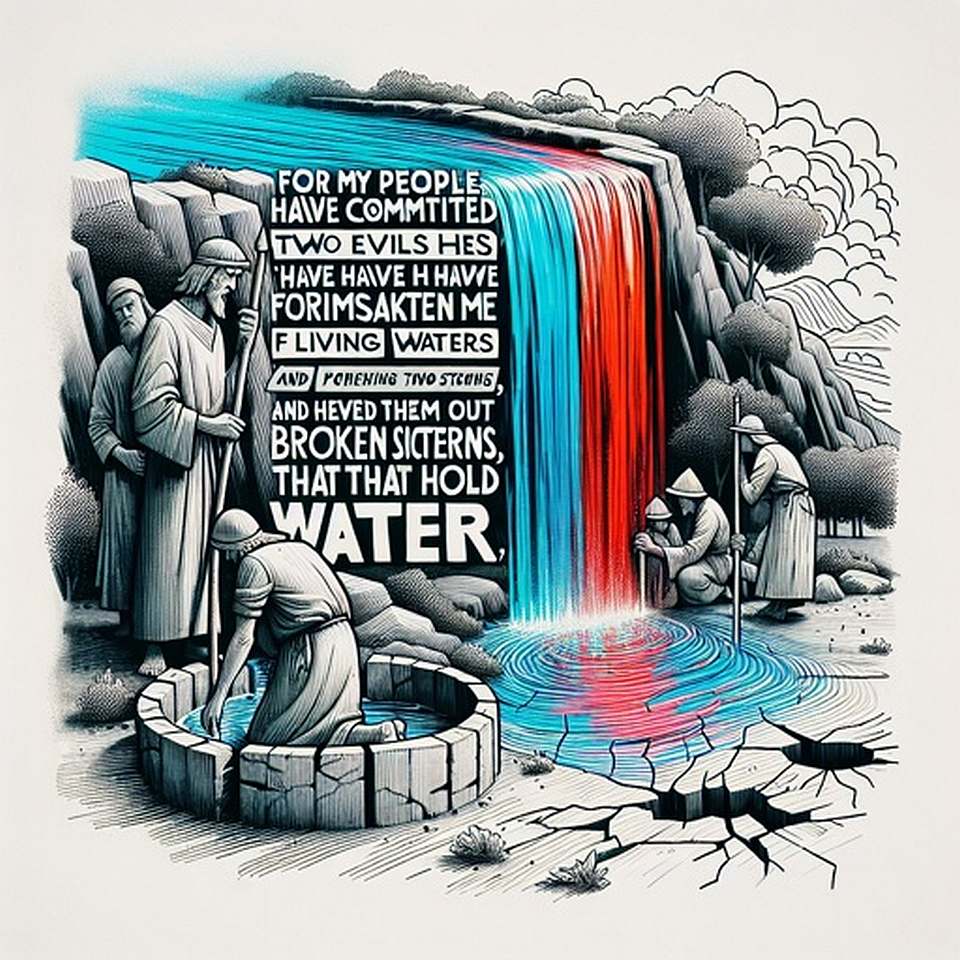
My people have committed two sins:
They have forsaken me,
the spring of living water,
and have dug their own cisterns,
broken cisterns that cannot hold water.

Now, when we think of a cistern in 202,5 we think of the container of water above the loo.

But this is not what Jeremiah was talking about when he gave this lecture to the people of Israel. For Jeremiah and the people of his time, a cistern was an artificial reservoir or tank used for storing water, particularly rainwater. These structures were crucial for survival due to the limited and seasonal rainfall. Cisterns were often dug into the earth or carved from rock, then lined with plaster to prevent leaks. They served as a vital water source, especially during dry seasons.

Cisterns were central to daily life because they provided water for drinking, cooking, and other household needs. In times of siege, a well-stocked cistern could mean the difference between survival and defeat for a city.

So a well-maintained and functioning cistern was essential for the individual and the community. I guess that it would also have been somewhat of a meeting place as people would gather to get the water they needed, much like we might bump into somebody down aisle 7 of the supermarket when we are hunting and gathering today.

Sometimes a cistern was used as a prison, and because Jeremiah’s not-so-quiet little reflection found its mark, some of his listeners decided that it would be ironically appropriate if Jeremiah finished up in a cistern. A cistern that he had claimed was broken. Here’s what happened.

“The officials of the king took Jeremiah and put him into the cistern of Malkijah, the king’s son, which was in the courtyard of the guard. They lowered Jeremiah by ropes into the cistern; it had no water in it, only mud, and Jeremiah sank into the mud.

But Ebed-Melek heard that they had put Jeremiah into the cistern. While the king was sitting in the Benjamin Gate,  Ebed-Melek went out of the palace and said to him, “My lord the king, these men have acted wickedly in all they have done to Jeremiah the prophet. They have thrown him into a cistern, where he will starve to death when there is no longer any bread in the city.”

Then the king commanded Ebed-Melek the Cushite, “Take thirty men from here with you and lift Jeremiah the prophet out of the cistern before he dies.”

So Ebed-Melek took the men with him and went to a room under the treasury in the palace. He took some old rags and worn-out clothes from there and let them down with ropes to Jeremiah in the cistern. Ebed-Melek the Cushite said to Jeremiah, “Put these old rags and worn-out clothes under your arms to pad the ropes.” Jeremiah did so, and they pulled him up with the ropes and lifted him out of the cistern.

It’s pretty obvious that Jeremiah’s message had made people petulant, but what on earth did he mean by

My people have committed two sins:

They have forsaken me,
the spring of living water,
and have dug their own cisterns,
broken cisterns that cannot hold water.”

In these little lines, Jeremiah is pointing out that they have abandoned God and gone after other Gods.

A "broken" cistern is one that is cracked or damaged, and therefore cannot hold water. This signifies that these man-made solutions cannot truly satisfy the deepest longings of the human heart. They may offer temporary comfort or pleasure, but they ultimately leave people feeling empty and unfulfilled.

That which is most precious to us and essential for us can seep away from us if our cistern, or our heart, is not right. If we are distracted and forgetful of Him who once described Himself as the living water springing up to eternal life.

The cistern, then, for us is that special place, deep in us, that we come back to to find him and replenish ourselves. It is so easily chipped and damaged by the cares and worries of our lives.

Thousands of years later, Jesus is at Jacob's Well, where he asks the woman for a drink, but in turn also offers her something much more. The living water.

And there are times in our lives when our own cistern has run dry and the living water has evaporated. When there seems to be nothing left to offer those who are closest to us, who need us most and perhaps even to replenish and refresh ourselves. It’s tempting then to shake our fist at God and ask for more water, but perhaps in our deeper and more honest reflection, we might ask ourselves why the cistern is dry. Perhaps water has been seeping out for a while to other places, other priorities, other distractions, and we haven’t realised it. Perhaps we weren’t attentive to the maintenance of that place within us where the living water sparkles.

There are times when we need to take time out to simply attend to the maintenance of our own cistern and make sure it is water-tight, and there are times when we need to simply say

Help, My Cistern is Busted!