We Are the Clever Ones

18/11/25

We are the Clever Ones… Right?

Each week, it is a great joy to be able to chat with my daughter. She lives in New York, and we engage in lively conversation thanks to a thing called Google Meet.  We swap stories and update on family news.

This is a first-world privilege not afforded to most of the world and would not have been available to our society 50 years ago.

We’re the clever ones… right?

But the advancement of technology and medicine over the past few decades has not stopped there. O  Lordy, Lordy no.

Think of the motor vehicle. It takes us from A to B and then onto 3.6 and back home again. It’s air-conditioned, plays music, and now comes with navigation devices that even the most ungeeky priest can work out and use competently. We’re the clever ones … right?

Think of the medicine and prescriptions that most of us of mature years rely on and the cleverness that was involved to test and refine these tablets to a safe and effective level. Where the clever ones … right?

And then we took travel to a whole new level where hundreds of people can get on board a tin cylinder and, in just over 24 hours, arrive on the other side of the planet. And don’t even get me started on space travel.  We most certainly are the clever ones … right?

But then, if we are so clever in this age of communication and connection, how come many feel nothing but isolation and loneliness? And boy… we sure know how to start a war. But,… we’re not quite smart enough and clever enough and wise enough to know how to end a war. Perhaps we have a ways to go. Perhaps we’re not the clever ones after all.

Bumpy Pickles

From the pen of 

Michael K. Marsh | November 13th 2022

I want to tell you about a friend who came and sat with me. They knew I was in a jar of bumpy pickles.

I was feeling overwhelmed, exhausted, lonely, stuck, and grouchy.  As I talked on in ever-diminishing circles, my friend wisely and astutely never actually told me what to do.

I think the questions of what we are going to do, what we want to do, or what we should do often occupy much of our time, effort, and energy. They’re not necessarily bad questions, but maybe they are not necessarily the first question.

Then my friend asked me, “What do you want the future to be?” He was asking me about my vision for the future. I think it’s the same question Isaiah is setting before us in today’s Old Testament reading.

No wonder I didn’t know what to do. How could I? I had no vision for the future. That’s why I’ve got stuck. “Where there is no vision, the people perish.” Proverbs 29:18

I was in search of a vision for the future, and I guess there is a sense in which I still am … for our community, for our parish and for the world.  Maybe you are, too. I think Isaiah has exactly what we need to hear today.

Not once in today’s Old Testament reading does Isaiah tell the people what to do. Instead, he offers a vision. It’s less about what to do and more about a direction in which to move. Isaiah offers values not just to be believed but rather to be lived and enacted. The vision he offers never ends; it’s always unfolding and enlarging.

He offers a vision of who God is and the desires, longings, and hopes God has for us. And it’s not just one thing. It’s a menu of beautiful, soaring, and poetic images of what life can be like. Each image is an entry point into the divine life. Take a look at the à la carte specials board. What whets your appetite?

What parts of Isaiah’s vision capture your imagination, ignite your passion, and cause your heart to sing out, “Yes! Yes, that’s it!”

Is it the part in which God says, “I am about to create new heavens and a new earth?” And if so, why does that grab you? What possibilities do you imagine? What needs to be created anew in you? How might you be a co-creator with God of the new heavens and earth? What kind of place do you want to leave to those who will follow you? What is this vision asking of you? Where and in what ways can you make a difference and bring about something new?

Or maybe it’s the part in which God says, “No more shall the sound of weeping be heard … or the cry of distress.” Wouldn’t that be nice? No weeping, no cries of distress, just the heartbeat of life. Do you hear the hope in that? Is that your vision for the future, for yourself, and others? That day is coming, but it begins today with our compassion, love, healing, and grace for ourselves and one another. Is that something you can give yourself to? If that’s your vision for the future, then what is being asked of you today?

How about that part in which God says that we shall not labour in vain and that our children and descendants will be blessed? Is that the vision that’s important to you, and if so, why? What do you see when you imagine work, the daily things we do, whether paid or not, that are meaningful and make a difference in the lives of others? What would that look like in your life? What’s the blessing you want to give others? And how might you become that blessing?

And there’s that part of the vision in which God says, “The wolf and the lamb shall feed together…. They shall not hurt or destroy.” It’s an image of nonviolence and reconciliation. Is that your heart’s deep desire for the future? What if we lived in a world of nonviolent families, schools, and workplaces; nonviolent political, economic, and justice systems; nonviolent cities? Is that what you want the future to be and, if so, how might you begin to cultivate nonviolence toward yourself, others, and creation? What relationships need reconciliation? How would you live a peace-filled life in your thoughts, words, and actions?

With each aspect of this vision, God is giving us wings to soar, but it is up to us to give the vision roots by which we ground it in our lives and the lives of one another. We need both soaring wings and grounded roots.

Imagine if we all took a piece of this vision and gave it our prayer, time, and energy. Imagine if we gave that vision roots in our lives and relationships, if we let it be the lens through which we see one another, if we let it guide how we think, what we say, and the things we do. Imagine the possibilities.

What does that look like for you today? What feelings does it  bring up in you? What does it inspire in you? What is it asking of you? And what might it offer you and our community?


I wonder what vision is taking root in your life today and what fruit it might bear tomorrow.

Bread for the Journey

Bread for the Journey

Bread for the Journey is the title of a book by Henri Nouwen. I was reminded of his book when watching a show on TV the other day. It was one of those programmes where a group of people are making a pilgrimage together.

The scenery, of course, is stunning, the bantering jocular, the participants are looking for something that is not necessarily their final destination, but rather that special something they discover about themselves and each other whilst traipsing along. Its great television and lots of fun.

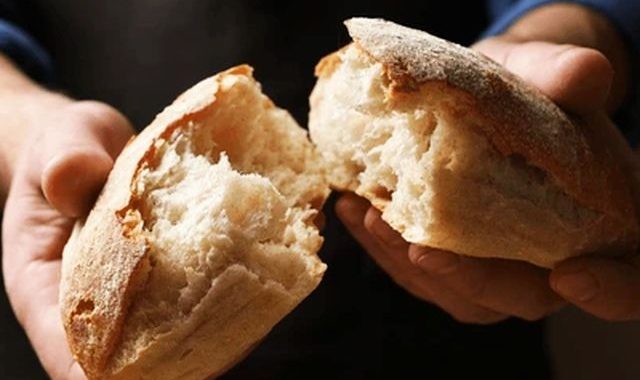
At one of their stops they are greeted by a beaming, jovial monk who welcomes his visitors with affection, deference and grace. And then he proudly announces that he has a gift for them. What might it be? Perhaps a signed copy of his memoir, a set or rosary beads, a history of the monastery? No… Instead he hands around a bowl and each person takes out their gift. It is nothing more than a wisp of bread.

How ineffectual. What use could a small chunk of bread be to those who were hiking over great distances and burning energy as if there was no energy crisis?

Turns out, of course, that the bread and its size were both symbolic as all the very finest gifts are.

Bread is one of the oldest forms of sustenance that we have and is used universally to feed and strengthen. And the size… sometimes it is the smallest gesture of love… a smile, the sacrament, a look, a word, a hug, a card… in the twinkle of these minuscule things we are fed most lavishly and memorably. For our homework we might reflect on those crusts of bread that we have been offered and how we might offer the same sustenance to others.

Treasure is Invisible

Treasure the Invisible.

Some time ago, we had a working bee here at Christchurch Hamilton. The day was overcast and coolish, but rugged up and looking like a bit of a dag, I cheerfully joined in.

The aim was to smarten up the grounds, get rid of excess vegetation, show the community that we take our care of the environment seriously, and offer a manicured ‘welcome mat’. There were heady discussions about the logistics of what needed to be done, the right equipment, and who would/could/should apply for these much-sought-after positions.

The skip filled easily and quickly. In fact, there is probably another skip waiting in the next-door departure lounge ready to go. The distraught and hapless flag pole was moved out of harm's way, and plotting began for a slightly different version. It now looks very hospitable, and you’re always welcome to see what we accomplished.

It was leading into the footy finals, so there was a bit of chatter about who might win and who might lose. Who had despaired of their team and whose heart had gone into arrhythmia with hope and excitement.

But there was something else that happened, and while it was invisible, I sensed it most keenly when we all stopped for a well-earned cuppa and delectable homemade scone.

The sense of camaraderie and teamwork, co-operation and conviviality was almost palpable. Together we had achieved much, and the sense of pride blended with mirth and jocularity was just as enjoyable as looking over the well-cared-for and much-loved grounds.

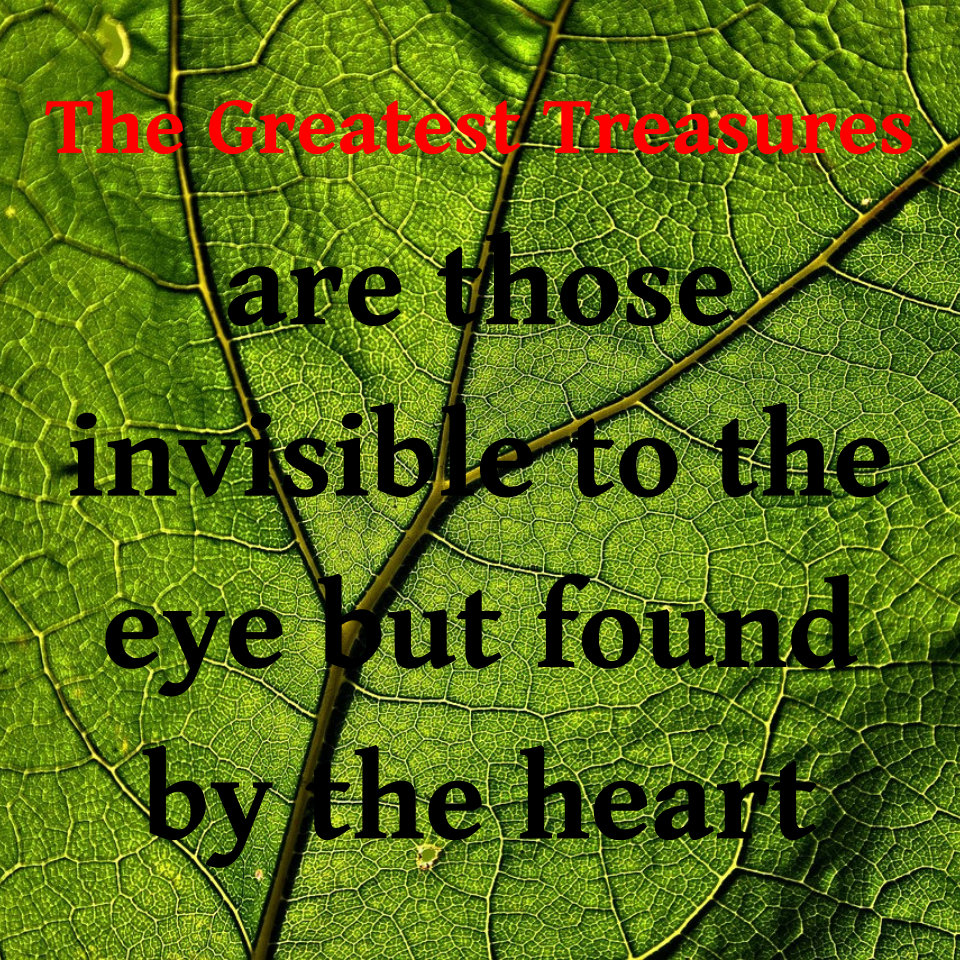
These invisible threads of companionship, encouragement and community are the deepest and sweetest treasures for me as a parish priest. They are not quantifiable, touchable or seeable, but it is these invisible things that I treasure most.

The Air is Thinner

9/11/25

The Air is Thinner in the 7th Dimension.

Today’s story really begins on Mt. Horeb, where a naive Moses turns aside out of idle curiosity to see a bush that is in flames and yet is not being consumed by the fire.

Mt. Horeb is not a remarkable place. Just your average rocky elevation with scant vegetation. It has an average annual rainfall that would make the most tenacious farmer quiver with fear and steal them of sleep. Nevertheless, it is on this rocky outcrop that Moses is about to discover that Mt. Horeb is where you encounter the Living God.

Moses politely takes off his sandals and then the Lord introduces himself, “I am the God of Abraham, the God of Isaac and the God of Jacob.”.

This title of God is the same one that the Master will refer to in today’s gospel in his cantankerous encounter with the Sadducees.

What’s the connection between Moses and these scurrilous Sadducees?

The Sadducees say that there is no resurrection. That's when our earthly clay exhales its last breath; that’s it. Life is over, and instead of the white light at the end of the tunnel, visions of angels and departed loved ones; there is absolutely nothing. That’s it, kaput!

The Master points out to this misinformed mob that this is not the Jewish faith at all. Come on, chaps, remember in sabbath school the story of the burning bush. God introduces himself to Moses as the God of Abraham, the God of Isaac and the God of Jacob.  You silly Sadducees, if we believe in a living God, then Abraham, Isaac and Jacob must still be living. Thus, life does go beyond the grave, but it is a completely different life from the one we know and enjoy now. Clearly, gentlemen, we love, worship and believe in a God who is timeless. There is a sense that when we are at the altar, we are also in that first upper room, as well as at the heavenly wedding reception, as well as being in our parish church all at the same moment. Yes, the 7th dimension is a boggling place not to be academically understood and disappear in a puff of logic, but to be lived in and experienced and relished.

Beyond the grave and in that dimension, there is no marriage because we shall be like angels. This is not to belittle the sacrament of marriage or disparage it. Marriage is great for this side of the grave, but as any married couple will tell you, it is not quite perfect. You do get a human being after all, and they come with their own glitter and they come with their slicing irritations. What’s more, marriage is always for a finite period of time. It doesn’t last forever. All marriages end in divorce or death. Sorry to be so brutal, but that is the reality; but sometimes, just sometimes, even in the most flawed of spouses, we glimpse something of the other. Those moments when we know that we are cherished, forgiven and enjoye,d and we wish that moment could last for eternity.

Interestingly, the most unlikely places and the most unlikely people (take Moses, for example, a murderer and a refugee) are exactly the places and people that are the very interface for divine encounters.

And there is a disquieting question for us to ask the person in the mirror. What if I am the icon, the face of the divine? Tarnished and bruised and lined but all the more beautiful and exquisite because of my blemishes. If God sees in me something of the beloved and rejoices in that, in my quirky nuances and silences, in my inextinguishable jocularity, I learn again that the Master can choose any complexion, any scar, any beauty to give us a glimpse of ‘the other’ and if He can see it in me, then I must take the time and put in the energy to see what He sees in others.

Something also needs to be said about our Mt. Horeb. There are places where the shroud between this dimension and the other dimension, maybe the 7th dimension, is incredibly thin. Your parish Church might be one of those places and it’s worth asking yourself from where is your Mt. Horeb? Where was, where is, that place where you are most centred, most you and He is most present for you? The place where without any fanfare or prior warning, all of a sudden you find yourself ‘there’. It’s not something you can book online. Sometimes, like Moses, we are just idly minding our own business in a geographical place that we know well, which is boringly familiar to us and then we slip through the veil and we find ourselves rubbing shoulders with Abraham, Isaac and Jacob. They find us, not vice versa. Or maybe we have just given ourselves the space to realise we were always surrounded anyway.  Then there is no need for trick Sadducee questions about brothers with a genetic heart disposition who keep on dying and leaving a distraught widow. We won’t need to ask the hypotheticals or shake our fist. Our tears will come not from the bottomless well of deep sadness, but spring out of a fountain of measureless joy.

Perhaps this is why the Sadducees no longer dared to ask him any more questions. Because they were in his presence, looking into his eyes and they found themselves in the presence of Abraham, Jacob and Isaac. The air had become thin and they were in the 7th dimension.

Face Value

Todays story begins at the Queen Vic market in Melbourne. It has a large veranda and sometimes they feed those who sleep rough there with a bottle of water and a BBQ.

Jeanine and I have stayed an inexpensive but comfortable hotel just around the corner from all this so we know the area well and we know who and what to expect. It’s not ritzy, it’s not sexy and glamorous and pretty much every time I have to check myself, remind myself, that I have no idea what has led these people to their destitution and I have no idea where and who they will be in 6 months time and what they will look like.

A mental illness, a case of abuse, the invisible scourge of  PTSD.

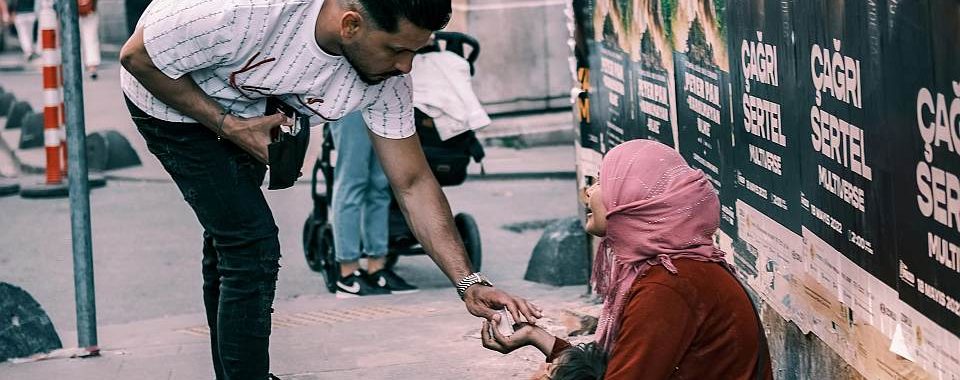
The trouble is that every time I consciously or subconsciously dismiss one of these little ones, I not only do a disservice to them, but, just as appallingly, I discredit and diminish my own self and therefore all my brothers and sisters. Everybody loses.

In his book ‘The promise’ Arnold Dix captures this eloquently and succinctly in his own encounter.

“I once gave money to a beggar on the street in Melbourne. The person I was with scoffed, telling me I had probably just been scammed. That immediate dismissal of a perfect stranger doesn’t sit well with me. Even considering that possibility gets in the way of the intention of my act to show someone a little kindness and some mercy.

Who cares if they spend that money on alcohol? Who cares if they don’t need it as much as they have implied?


When we do not take each other at face value, when we discard people because they do not act or look like we think they should, we do a disservice to each other as human beings.”

All Souls Day

2/11/25

All Souls Day

By a lovely coincidence, All Souls Day falls on a Sunday this year. Our day of resurrection. The first day of the week, when the women went to the tomb whilst it was still dark. They came expecting to find a sealed grave. But instead they found an empty tomb, a couple of angels and a ‘gardener’ in mufti. They came with spices expecting to anoint a corpse. They were given a different task. To spread some excellent news and all of this would have required a lot of trust and oodles of prayer. Trust is what we always do whenever we pray.

For the recipe of prayer always has a hefty wodge of trust. You can’t have one without the other. Like yeast in the bread or sugar in the chocolate. It is in our trusting, in our reluctant handing over of our departed, that we allow the possibility of peace and love to surround us. This is a harrowing task as we relinquish those who are most dear to us. And there is a big part of us that does not want to let them go. We’re really not quite sure that we can hand them over. We don’t know if we are ready, and perhaps, if we are ruthlessly honest, we never want to release them.

But what if, in fact, we don’t send them away from us, but rather entrust them to that other dimension, maybe the 7th dimension, where in fact they are actually closer to us in a special way that is both mysterious, poignant, and lovely. For in handing them over, we also commend ourselves.

You see, when someone we love so deeply and dearly goes over to the other side, a large chunk of ourselves goes over with them. To entrust our loved ones to an invisible God is to entrust a substantial part of ourselves. But we want to be in control of all of ourselves 100% and All Souls Day says that the number is wrong.

Can we really put aside our need to control? To allow what God wants, to replace what we want, what I want, what I need.

This is tough because often this purportedly loving God will, in return for our faith and our loved ones, give us questions instead of answers. He will take our laughter and give us tears. In return for our delectable memories, he will exchange a cup of futility and ache. But if we can surrender ourselves completely or begin to, or at least say that we want to, we come to understand that he does not take away the serrated knifing throb, but rather that His own piercing is actually our piercing. His tears for Lazarus… are our tears for our loved ones.

So slowly we begin to glimpse the reality that in our mourning, we are not separated from him at all, but he is right here with us. Not distinct from our torture, but immersed with us at the altar in our broken bread and hearts. No earthly thing can separate us at all. It just looks like it, and boy, it sure feels like it.

It is a long and very rocky road with boulders, futility and dust. Perhaps it will take a lifetime with lots of tricks and trips. We all know of times when we thought that we were travelling pretty well, thank you very much. We’re going OK. I can do this. And then from nowhere … a piece of music, an aroma, a photo, the compassionate unexpected word and all of a sudden we find that we are sprawled lying in the dust, weeping helplessly…. again… We didn’t see it coming, but here we are, tripped up, surprised by grief and surprised by the potent poignant privilege of having loved so very deeply for such a long time.

There is a sense in which the helpless and demolished loaf at the altar is the only thing that begins to make sense of that emotion and dark place which has always defied comprehension, words and logic.

This is my body broken for you. This is my blood poured out for you. These are my tears that I have shed for you. And when we have said that and begun to understand all that, when we have to come to that place where we have used up all our words and we are left with none. When we are gutted and empty. When we admit that we have no understanding but only raw emotion, when the last sob has escaped us, and we resignedly lower our furious fist of ‘why’.When we have lived eucharist, then, and only then, can peace and love begin to seep in and start to envelope us.

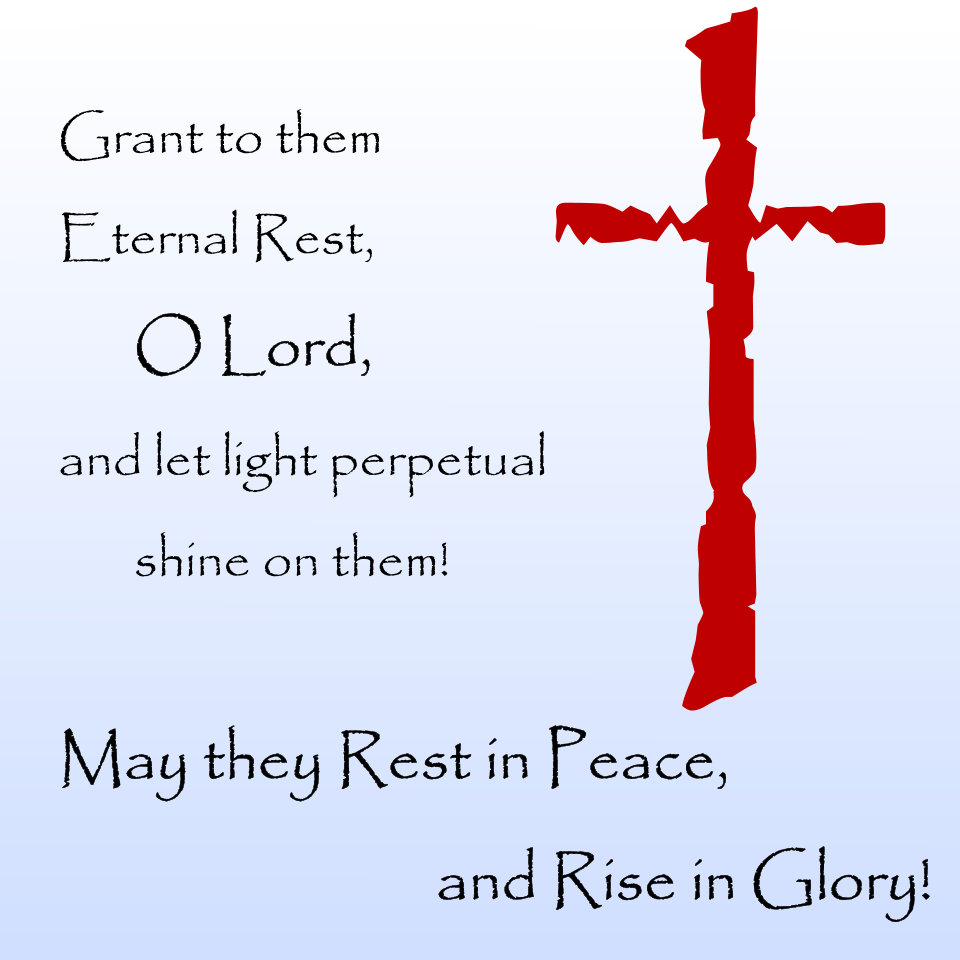
So in the last, reunited with our brothers and sisters, when we lie in the dust of our own grave, we will discover that peace and love surrounded us, and our burning desire to rest peacefully and eternally in you will finally be accomplished.

Lord, may no earthly thing
ever separate us from you,
But may everyone and everything support us
with a burning desire to rest peacefully and eternally in you.
Amen.

So, What Happened Next?

26/10/25

So What Happened Next?

Our story today begins in Portland where the wise old supervising priest sends me out to visit a home where he knows I will be well received. He knows that I will be  fed delicious cream cakes and caramel slice and maybe washed down with a refreshing beverage. ‘Only one mind Fr. David. Mrs. Gonzales makes a very serious G n T.’

Chat about the wedding photo you’ll see on the mantelpiece and you won’t be stuck for conversation.

And my supervising priest bless him, was absolutely right.

The cream cakes were delectable, the caramel slice to die for and yes, one G n T was more than enough. He was also right about the wedding photo on the mantelpiece. It sparked a jocular, witty conversation and Mrs.  Gonzales looked smashing in her wedding photo whilst the striking gentleman by her side actually turned out to be the first of three husbands she had the pleasure of sharing her life with.

You would never know this in the singular photo of the first wedding. It takes yummy treats and a heady G n T to deliciously tease out what happened over the years.

All that is just a very jaunty way of explaining that in the gospel we are only given a snap shot of what happened in the story. It’s very much like a photo or a short reel of action. Nothing less, but certainly nothing more .. We are left to our imagination and speculation as to what happened the next hour, the next day, the next year.

This can be both infuriating as we wonder what happened and it can be a lot of fun as we are not limited in any way to the future scenarios. Everything and anything is up for grabs.

Todays gospel story about the rich young man is a classic example of this kind of tease.

Here’s a few wild guesses about what I think may have happened after the business broker goes away sad.

Given the virtuous status of the rich man when he arrives at the feet of Jesus, the way Jesus sees into his heart and looks at him with love, the instant recommendation from Christ that he leave everything and follow Him,  I don’t think we can ever safely conclude that the young man never accepted Jesus’s offer.  In fact, I think quite the opposite would be more likely.  How swiftly we can dismiss others on the cursory experience of a first meeting.

What if next week or next month or even at the end of the financial year, the wealthy young man cashed in, sold up, went down to Anglicare and did what the Master asked of him.

Jesus was always ready to teach His disciples new lessons on what it meant to be His follower, He knew what words would most effectively benefit the young man for his salvation, as well as the words which would help His disciples understand His mercy and love for them.

The rich young man had everything going for him. Not because he was wealthy, but because of the virtue he had acquired through following the commandments of God faithfully all his life.  Jesus already knew him through and through. He must have known, too, that he would not be able to embrace His challenge immediately like Matthew, the tax collector.  But that was okay.  It gave Jesus the opportunity to reach out to those around Him and through time to you and me. Jesus revealed what the power of His grace and mercy is like.  If our heart is open to grace, God’s mercy can accomplish in us what would otherwise be impossible for us to accomplish on our own.

The Master gives the rich young man no less a chance for salvation than you and I when He says that “for humanity, [attaining salvation] is impossible, but not with God.”  The really good news is that Our God does not turn His back on those who strive to be faithful.  He is most eager to help those who have fallen out through weakness.  Did the rich young man return to take up Jesus’ challenge?  I like to believe he did.  It gives me hope in the unfathomable mercy of an ever faithful Father, who never tires of drawing us to Himself in persistent love.

Just like with the rich man who went away sad, discouragement will get the best of everybody. This will happen many times during our lives when challenges in life seem too ferocious.  The important thing is to bounce back in faith, to continue to practice virtue to the best of our abilities. Thereby we remain open to the workings of grace in our souls. In the end, our eyes are cast on the inestimable treasure we were able to store up in heaven, not just for ourselves, but for many others as well.


What happened next with the wealthy young man is a great question. The better question is what happens with you and I.

My Misspent College Days

My Misspent College Days

My college years were heady days of lectures, wine, song and prayer. We wrote essays, or tried and we used to have these things called tutorials. A hapless student would be asked to prepare a paper and the others would savagely tear it to pieces, arguing the toss and pointing out the flaws in the logic. I think today we would call it a healthy, robust debate but at the time it seemed cruel to those who were of a more sensitive nature. We spent a lot of time trying to figure out the theological niceties of the divine and proving that somehow we were the gatekeepers and guardians of the impeachable truth.

It was not until I heard a line from a colleague some 40+ years later that I began to see things from a much healthier perspective. My friend said something like this.

‘What if, it is not about what we think about God on any given day, but rather it is about what God thinks of us each and every day. Maybe if I had heard those words, grasped them, clutched them to myself and integrated them into my soul, the last few decades may not have been so torturous.

For the truth that I have come to understand, nearly too late is that I can argue the toss and ponder and panic about the unfathomable God, but my energy would be more fruitfully expended in just allowing the delicious reality that the Master adores me and wants to continue to engage with me, even when and especially, when I have been at my most ghastly and shabbiest.

It is not about what I think of God on any given day. It IS about what God thinks about me (and you) each and every day.

Of Bunions and Pesky Widows.

Of Bunions and Pesky Widows.

Dear David,

Thank you for the gift of your morning prayer yesterday. I found it particularly moving and poignant, to the point where I wanted to offer a response and engage with you more directly.

I have to say that I am impressed with the way you keep on praying for the removal of the bunion on your left little toe. It is a pesky blight, and it seems that nothing will budge it. Not even your conversations with me.

I well understand that this must be a source of pain physically, emotionally and psychologically. Yes, I know that it has dramatically blown out your personal best times at Parkrun, but I am hoping that this quirky little exchange might put some things into perspective for you.

I guess the most worrying part of your ailment is not the bunion itself, but rather the way the acid of disappointment has begun to eat away at your otherwise sunny disposition and the relationships that you enjoy so much and revel in.

You’re right in referring to today’s gospel with the widow who continued to go to the ambitious judge. The one who was more interested in meeting budget deadlines and key selection criteria than he was about delivering justice for the underprivileged, the manky stranger and the different who came to live in his community.

The moral of the story is not only about persisting. The subtext, which I fear you may have missed, is that you should not lose heart. That our prayer should not just be about getting justice, but it should also be that discouragement and disappointment must not beat us down and bruise us beyond repair. This is the real danger of your bunion, not the ‘ouchiness’  when you put on your sand shoes. It is what is going on inside that has a direct and palpable effect on what happens on our outside, even our bunions and piercings. And it works the other way as well. From outside to in.

My outer, physical, viewable piercings and lashings were a showing forth of the love that was on the inside for you,  your family, your patient GP, your parish, and indeed the whole world. Not everyone got it, but I know that you do, and you certainly did at Morning prayer yesterday. And boy, you really get it when you stand at the altar and break the bread. You show forth to anyone who is looking that the bread cannot be shared and enjoyed unless it is first broken. Then and only then, can grace be made visible, touchable, tastable and ingestible.

I came and I come, not to rid the world of bunions, demonstrations, angry words, cold-hearted judges and irritating widows, but to be in the midst of all this. To be physically flesh and to make holy that which seems irritating and unflinching, especially the bunions and the pesky widows.

So tomorrow morning, when I tune into morning prayer, when you settle yourself down and begin to breathe as you do so steadily, rhythmically and beautifully, before you open your lips and look at the screen for the prompts, ask yourself … what am I really here to pray for? Is it the bunion, the widow, or would my prayer be more helpfully labelled and nested under that which is within? The sense of my closeness, because I am close to you, nearer than hands and feet, closer even than your breath.

By all means, pray for the war to cease and the blood to stop flowing, but first have a serious look at the static and distortion that rages in your own soul, and perhaps together we might begin by properly tuning into each other first. What is it you really need? Then we might get around to what you want.

Allow my grace and activity to saturate you. You are restricted by the invisible wibbly wobbly cords of time and space. You won’t always be, but just for today, please understand that even with these encumbrances, your humanity can show forth the reality that you are impregnated, saturated with the grace that you need.

One more thing about the parable of the widow. People usually assume that it's a story about the widow approaching a judge. About us approaching God and how we should always persist. That is only 50% of the parable.

Try flipping it the other way round. Consider the possibility that it is I who is the nagging, the persisting, relentless God who continuously approaches you and will not give up on you, even though you frequently appear to be preoccupied, self-centred and busy doing other seemingly more important things.

Cousin John had it right. I am the still small voice that calls in the wilderness. I am that voice that nags you to do the right thing because it is the right thing. I am the one who consciously reminds you that all I really need is to come to the altar and simply enjoy me. But watch out!


I am more tenacious, more relentless, more nagging, more persistent than the widow, and I am more stubborn than your bunion. Long ago, I was transformed into you, and ultimately you will be transformed into me… forever and ever, Amen.


The Openings and Closings we call ‘Funerals.’

The Openings and Closings we call ‘Funerals.’

Even after 40 years, I still regard it as a poignant privilege to attend a funeral. Perhaps more so now that my own funeral draws ever closer. Frequently, I’m the person up front trying to make sure that it all goes smoothly, but at the same time not drawing attention to myself. It’s not about me. It has never been about me.

Someone popped up once in the back row of the funeral whom I didn’t know. We got chatting at the wake over a couple of frothies and some sausage rolls.

In his own words, he had come for ‘closure’, and what lay behind his comment I take to my own funeral and grave.

But he was right. Funerals are about closure. What is past and gone must now be commended to the past and gone. We may not forget about the person, but we can never get them back again, no matter how much we might ache to.

Funerals are also about opening. We are invited to a different, new, wonky, rocky pathway. One which, if we are honest, we would rather not have to stumble along. But we have no choice, and pained and grumpy as we might be, this long and tortuous path is the one we must tread.

Some of us are crazy enough to believe that the one we think we have left behind often walks with us. Encourages us, maybe even weeps with us and always cheers us on. For them to,o something has changed. There is closure on their past life, but what if in dying to this world they live refreshed, liberated and renewed in another dimension where the distance between them and us is disconcertingly thin. Closure and opening coexist in the same place and at the same time.

You Need to Hear This

You Need to Hear This!?

One day, a friend kindly passed on his gratitude. I quickly fobbed it off and replied that my actions were just what I do. It is who I am.

Swiftly, he replied, ‘Yes, but you need to hear what I am saying. ’ He was congenially firm, and it made me pause and take notice.

His polite insistence for me to pay close attention to his thankfulness was ringing in my ears long after I put the phone down.

Now there are two bits in his one sentence. First, there is my need. There is a part in all of us that has a need to accept recognition and gratitude when it is offered. To own it and accept it as an integral part of ourselves. We should not simply brush off heartfelt and authentic comments from others. We need to understand that we actually do some good stuff sometimes. Sure, not 100% of the time, but all of us want to leave others and the world a better place. And while we might fail sometimes, all of us strive to achieve a high standard and set the bar accordingly.

The other bit to my friend’s comment is the word listen. I wonder how many times I have been spoken to and not really listened. How many times has someone written to me and I have passed it off as old so and so, just being polite and minding their manners? Most of the time, people really do mean what they say, and if they didn’t mean it, they wouldn’t say it. It is especially powerful, I think, when they have actually made the time and expended the energy to write a letter.

I need to Listen with a capital L, not just to show the appropriate respect to the speaker, but for mine.