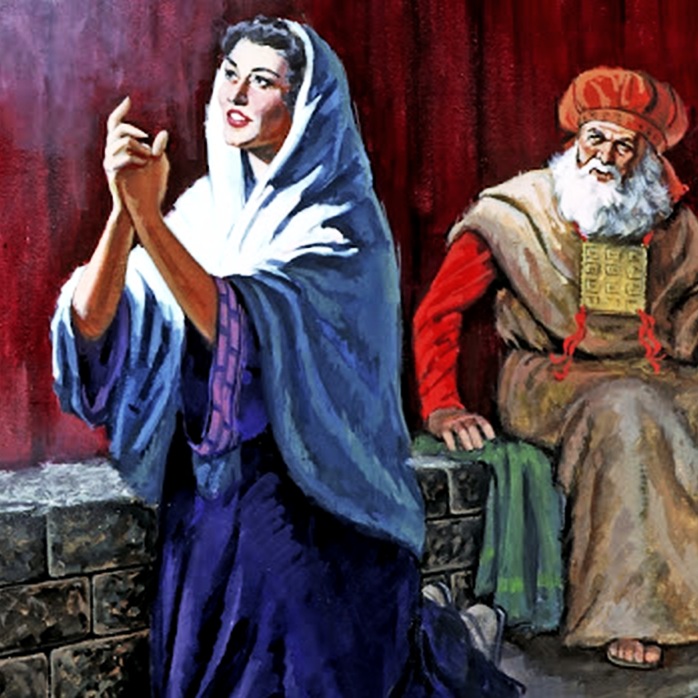
A Hannah Kind of Hurt
Today I would like to reflect on the story of Hannah in the Old Testament reading.The book of Samuel comes in a 2 part mini-series. These two books of Samuel tell us about the difficulty Israel had in transitioning from a loose system of judges to having a King. Hannah’s story is in the first episode of the first series. As we read, we discover her story is essential to Israel's big story. When our story begins Hannah doesn’t know it. In fact, she would never know how important she is/was.
Now the Bible seldom highlights a woman’s story, so when the book of Samuel opens up with the story of a woman and a barren one at that, we are immediately put on notice. This is not business as usual. Something quite remarkable is about to happen.
In a world where barrenness was considered a curse, only the birth of a child could complete Hannah. Day after day, year after year, she had to live with a pain in her heart that would not go away. Her barrenness was an “unsettled ache.” The worst turmoil of all often takes place in one’s own soul. This happens when you can’t seem to live with yourself, when your own pain, anxiety, depression, and regret eat you up, leaving you with an unsettled ache. You are at war within. You have a Hannah kind of hurt.
An unsettled ache lingers no matter what one does. Possibility thinking, positive psychology, words of affirmation, wishing, hoping, and even praying don’t make the hurt go away. It is an unwelcome guest that overstayed its welcome long ago. Unlike hurts that are at least manageable, this type of hurt affects one’s entire life, leaving the heart wounded and the spirit broken. This type of wound impinges not only on life circumstances but also on one’s sense of self as well.
This is a “Hannah kind of hurt.” This kind of hurt can lead to addictions and “emotional disorders” since people will do just about anything to relieve the agony as they “search for escape — some way to numb the pain, remove the anguish, and discover some momentary peace.” Hannah resorted to no such escape.
As if the taunts and shame of being barren were not enough, Hannah has a couple of other things going on that are not pretty and not pleasant. For one thing, there is Hannah’s husband, Elkanah. He just didn’t get it. Thinking himself better than ten sons, his inept and misguided words of comfort actually made things worse.
So we get
“Her husband Elkanah would say to her, “Ah Hannah my love, my turtledove, my darling… Why are you weeping? Why don’t you eat? Why are you downhearted? Don’t I mean more to you than ten sons?” Every marriage counsellor and divorce lawyer's dreams come true. Now if you were Hannah, wouldn’t you just want to pick up the nearest stone water jar and do the very logical thing?
But there's more. Thinking herself better than Hannah, Peninnah, Elkanah’s other wife, has a disdainful attitude towards Hannah. She repeatedly boasts about her fertility leaving Hannah shattered beyond words. And I imagine Hannah suffered the same sort of snubs and disdain whenever she went to buy the fish, bread and olives at the local market.
But there’s more. Adding injury to the blithering insult, Eli, her insensitive parish priest, accuses her of having too many raspberry cordials.
So we get
“Eli observed Hannah’s mouth. Hannah was praying in her heart, and her lips were moving but her voice was not heard. Eli thought she was drunk and said to her, “How long are you going to stay drunk? Put away your wine.” ”
Professional standards would wipe the kitchen floor with this guy.
Despite her ‘Hannah Hurt' she chose not the path of retaliation, retribution and the stone water jar treatment. She takes her concerns to God. Just as David is explicitly described as a man after God’s own heart, Hannah implicitly is a woman after God’s own heart. Like David who later would refuse to harm God’s anointed King Saul, Hannah refuses to retaliate against her rival, Peninnah or her husband.
Although Hannah does not share the details of her situation, Eli eventually understands that hers was a heartfelt cry. Thank you, God. There is hope for unthinking priests. Assured by Eli that God had heard and would answer her prayer she went home, confident that God’s answer would present itself. God’s answer does come when she gives birth to Samuel, Israel’s last judge, the prophet who would in turn anoint Saul and David, Israel’s first two kings.
When we read Hannah’s story in its totality and look back, we understand that the story of Israel’s transition and subsequent events cannot happen, and cannot be told, without first telling Hannah’s story and her hurt. Her hurt and what she does about it is an integral part of Israel’s transition. Israel’s story cannot begin without her. Of course, Hannah would never know it on this side of the grave, but we do and we are inspired.
The message of the story is of course that while we might think that what we do on this side of the grave and our little life is of no consequence to the bigger picture that God has in mind, in actual fact, every action, and word and thought is important to God. Every conversation, every misunderstanding and petulant niggle is important. Even our own ‘Hannah hurts’ are a necessary part of God’s continuous unfolding plan. Something to think about when you have a Hannah kind of hurt.