12/7/26
Hairy and Grabber
Usually in the homily we go straight to the gospel reading and have a bit of think and play there.
Today’s first reading, however, is a cracking story about a family with all its sparkle, joy, failings and contentions. As such, it is a good story for us, for we all belong to this parish family, to say nothing of our own families. So let us begin.
Rebekah, the matron of the story, is barren, but after a prayer from Isaac, she conceives a child. But instead of one child, she discovers that without the aid of an ultrasound, she is to give birth to twins. How clever! She finds this out because, literally, “The boys were crushing one another within her” Rebekah’s response to this crushing agony inside her is to confront God, who reveals to her that “two nations are in your womb” (Gen.25:23). Well, no wonder she feels crushed! Two nations!
Finally, the big day arrives, and “the first one comes out red covered with hair like a cloak, so they named him Esau,” a name which sounds like the word for “hair.” In families we often give each other nicknames, so I’m going to call him “Hairy.” Then out came his brother, with “his hand grabbing Hairy’s heel, so they named him Jacob,” a name based directly on the word for “heel.” I’ll call him Grabber since that is what Jacob will do subsequently in his life; he will grab for everything he can get, as today’s first lesson demonstrates!
Hairy and Grabber quickly grow up; Hairy is “a hunter, an outdoorsy guy,” think of the Leyland brothers. Grabber, on the other hand, is “a simple man, a tent dweller”.
Interesting, isn’t it, that two siblings from the same gene pool, with the same upbringing, with the same parents, born on the same day could turn out to be so different. Perhaps you know of siblings like that.
Sadly, it seems that the parents Issac and Rebekah have favourites. Another family quirk you might have noticed in families. Daddy Isaac favours ‘Hairy ’, the outdoorsy hunter, whilst Mother Rebekah favours ‘Grabber ’, who stays at home and helps with the washing up, the cooking and the laundry.
The author is keen to contrast the two boys wildly: one is a vigorous outdoor hunter while the other is a mummy’s boy, living inside much of the time. Grabber will also reveal his true nature as a master of deception and trickery. One day, Grabber is putting the finishing touches on a stew. It smells fantastic, and Hairy rushes into the tent famished. It has apparently been a poor hunting day, and he simply must eat. “Quick, let me have some of that stew,” he shouts, “for I am starving”.
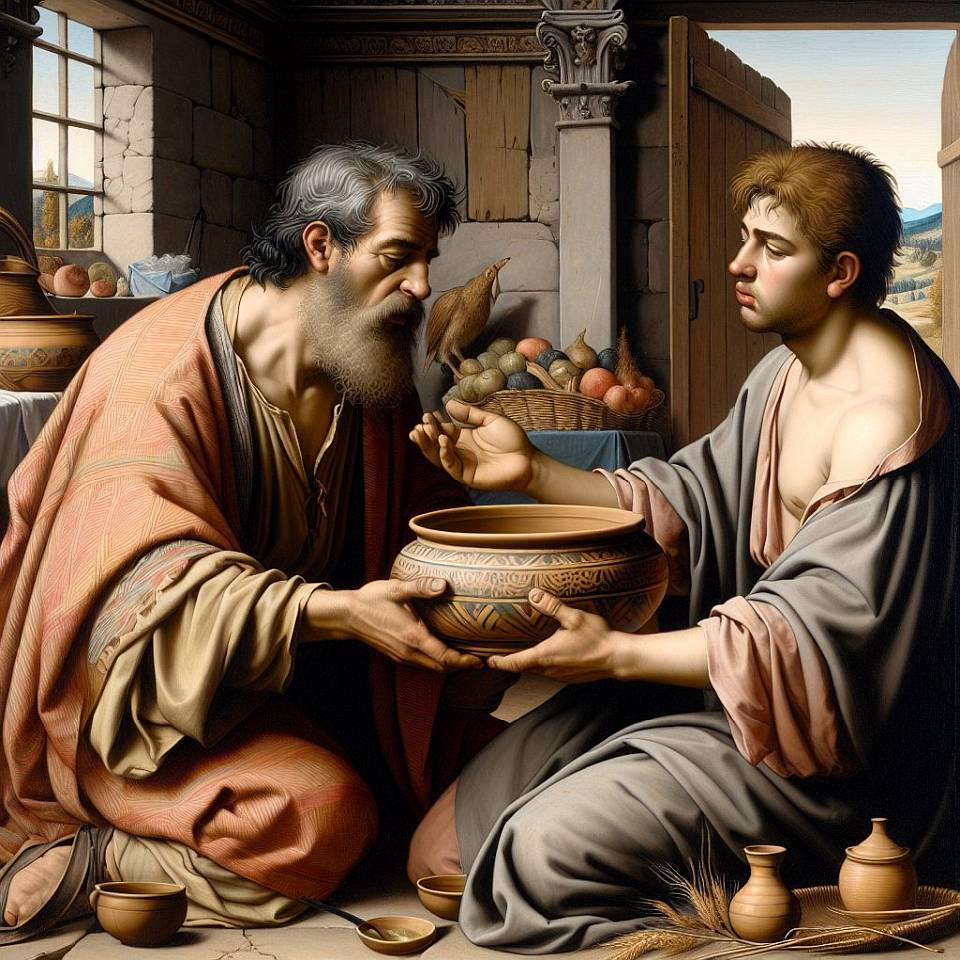
Adroit and astute, quick-thinking Grabber sees an opportunity and says “Sure; but first, sell me your birth-rite”. The birth-rite is, of course, Hairy’s rights as the firstborn, the right to property, goods, and all the future promise of leadership of the tribe. It is, in short, his complete future existence.
His reply to this outrageous request is about as stupid and absurd as it can be! “Oh well, look! I suppose one day I’m going to die anyway, so what the heck. What in the world is a birthright to me? Besides that, I’m really hungry, and the stew smells delicious.
“But, not so fast!” Grabber says, “Swear to me now”, demanding from his gullible brother the ancient equivalent of a stat dec.
With no hesitation, the doltish Hairy swears to him and thus gives him the birthright. The text then markedly speeds up. “Grabber gave Hairy bread and lentil stew; he ate, drank, got up, and left” One can imagine a burp of satisfaction as he rushes from the tent. Thus Hairy “poured contempt on his birthright.” This sad tale is marked by both deception and naivety; Grabber gets what he wants, the right of the firstborn, and Hairy is deceived and left alone in the field.
No one comes out of this story smelling of daphne and perfume.
The parents both have their own favourite son.
Hairy is ruled by his tummy and doesn’t understand what he is giving away. Grabber is deceptive and self-serving. Yet it is out of this family and its descendants that the Almighty makes a great nation from which our Lord was descended, and therefore you and I as well.
We get another reference to this in the first line in Matthew’s gospel. In his genealogy, Matthew has…
“Abraham was the father of Isaac, Isaac the father of Jacob.”
And if you are very brave and open up that genealogy wardrobe a little more, you’ll discover a few more shadowy goings on and skeletons.
‘David was the father of Solomon, whose mother had been Uriah’s wife’. Mmm
It’s almost as if our loving Father makes a conscious choice to use the most appalling families to bring about his greatest triumphs. But then, human beings are all he has to work with. People like you and I, who, if we are honest, can see a little bit of ourselves in Isaac, Rebekah, Hairy and Grabber. Human nature has not changed that much over the years, but then neither has God’s love and willingness to transform the wreckage of family relationships into angels and archangels, seraphim and saints. And that, my friends, is very good news indeed.