Easter 3 14/4/24
‘How do you like your fish?’
On our menu today you can have battered and deep-fried; roast or baked; pan-fried; poached. Or, how about broiled?
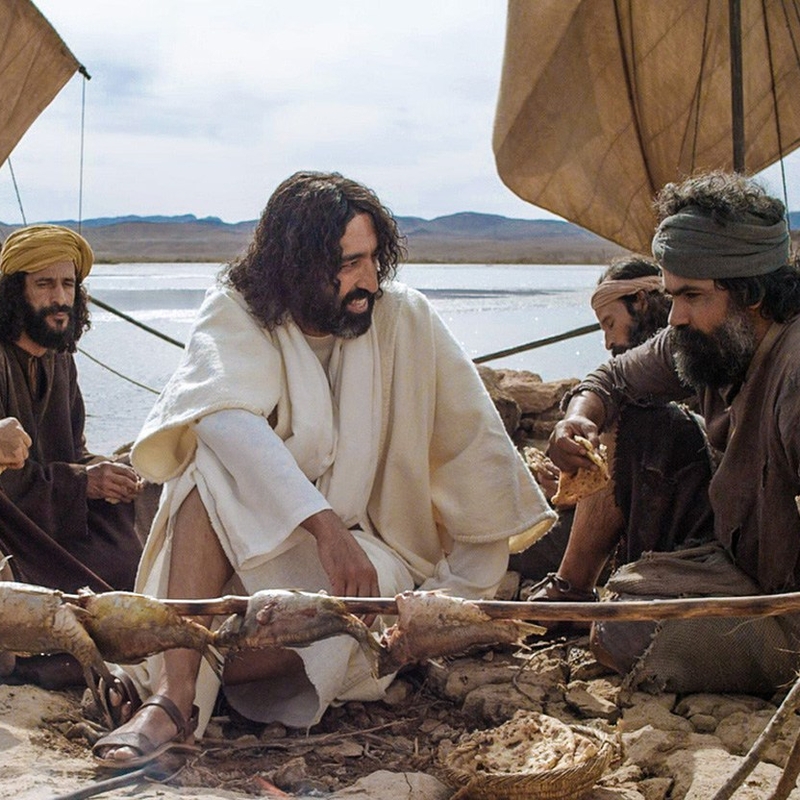
In the Gospel the disciples gave Jesus a piece of ‘broiled’ fish to eat so that Jesus could prove to them that he was ‘real’ and not a ghost; When I read this, I realised that I didn’t actually know what ‘broiled’ meant. So I spent some time by the flickering light of the computer and I learned that broiling is ‘cooking by exposure to direct radiant heat, either on a grill over live coals, or below a gas burner or electric coil’.
The first of these options is all that would have been available back in the first century AD, and is basically what, today, we would call barbecuing – cooking over charcoal. This echoes with another resurrection story John’s Gospel where Jesus was cooking fish for them over a charcoal fire for breakfast.
But there’s a more significant aspect to this than how Jesus likes his fish cooked. We’re told the main reason that Jesus asked for something to eat was to prove to the disciples that he was ‘real’ – that it was actually, really truly him as fully human flesh and blood. After all, only a ‘real’ person – not a ghost – could eat ‘real’ food. So why didn’t Luke just tell us that Jesus ‘ate some food’; or even that he ‘ate some fish’? Why did Luke specifically state that ‘They gave him a piece of broiled fish, and he took it and ate in their presence’? What’s Luke trying to teach us here?
Well, perhaps Luke gave this specific detail because he was keen to show the reality of Jesus’ appearance – that it really did happen. Like a witness in court, the more vivid detail they can provide, the more credible they are.
So Luke is helping us because he knows that the hardest part of faith is actually realising (that is, feeling as well as academic knowledge) the truth of what we say we believe. This is a continuously difficult thing for any disciple. Just look at the disciples: they’d lived with Jesus day-in and day-out for three years; they’d witnessed all his miracles, heard all his teaching, been given privileged additional insights. And yet, when faced with the risen Christ, Luke tells us that they were ‘startled, terrified, disbelieving and wondering’.
So, if it was difficult for those first disciples, how much more so for us, to ‘accept the reality’ or ‘realise the truth’ that God is real and that Jesus is the real personification of God.
Indeed, this slippery grasp onto the living reality of what we believe goes right back to Moses, when he asked how God should be identified to the Israelites, God replied simply, “I AM”! Perhaps what God meant by this was that, “If you really want to know what is really real, then ‘I AM’”. Indeed, God is more real than anything else, because He is the source of everything that we consider real. What Moses, what the disciples, and what we must realise, is that God is more real than anything else.
It might help if we unpack the word ‘realise’. It's the word ‘real’ with ‘ise’ on the end. Its dictionary definition is to ‘become fully aware of something as a fact; to understand clearly’.
So how do the gospel writers help us become fully aware of the resurrection as a fact?
By telling us resurrection food stories. We connect so very strongly with food stories. Remember another of Luke’s stories where the risen Jesus walks unrecognised with two of his disciples. It was only after they arrived at the village of Emmaus, and Jesus broke the bread at the dinner table, that they finally recognised him. Then there is the scene with Peter and other disciples after a long day of fishing. They see the risen Lord calling them from the shore. When they arrive, they find that he has cooked a breakfast of bread and fish for them and invites them to “Come, have breakfast.” (John 21:1-14)
So what else will help us feel and know the reality of a physical, touchable, tangible, palpable, body resurrection?
Jesus did some other curious things right after the resurrection: like breathing on his disciples and inviting Thomas to actually touch his nail wounds and feel the sword gash in his side.
These resurrection touching, feeling, scenes drive home not only help us to understand the resurrection but teach us the importance of the human body. For Jesus, his physical body wasn’t just something that he “wore” while on earth, but part of his very being. And for us, our bodies are not something solely for this life which we forever discard at the time of death. As human beings, we are a beautifully mysterious combination of body and spirit. Just as in the Ascension, Jesus took his resurrected body with him back to the Father, we, too, at the end of time, will receive back our glorified body for entrance into heaven. The body is a profoundly good part of how God created us. The body is holy—thus what we do with our bodies and what we do to other peoples bodies really does matter.
Flesh and spirit are not at war. They are actually exquisitely complementary. They need each other and they find that perfect union in Him who liked his fish barbecued.
For your reflection you might like to recall your favourite bible food story and why it appeals to you?