Lent 5 March 17th
Bishop Stephen Cottrell
He ate with tax collectors and sinners part 2
Another shadow crosses the day. They stare at him, dumbfounded. He is very irritating. Not only does he accept this woman’s offering. Not only does he shame them in front of her, reminding them that there will always be poor people to serve.
Now he says that he won’t always be around. He says that this anointing is for his burial.
Everyone looks aghast. It is good to sit and eat with him. But it is also so hard and uncomfortable. He is one of those people that as soon as you think you’ve got him worked out goes and does something to confound you.
They sit around his table and they are covered in embarrassment. They don’t really know why. Nothing is as they expect it to be. Have they come to Jerusalem for life and for victory, or for death and defeat and will they even know what each one looks like?
They know the religious authorities have it in for him. But there isn’t really any evidence. Apart from this. Their constant gripe: he eats with tax collectors and sinners. He doesn’t deny it. He revels in it. He seeks out the lost. He embraces those who must not be embraced. He makes himself unclean and then calls them – the scribes and Pharisees, the keepers of the law – dirty. That was their complaint. And he gave as good as he got. He called them blind guides who strained a gnat but swallowed a camel; whitewashed tombs that looked lovely on the outside but inside were full of bones. He called them hypocrites who did not go into God’s kingdom themselves but stopped everyone else. And when they complained about him and the company he kept, he just smiled and said, ‘Those who are well have no need of a doctor, only those who are sick.’
Sitting round the table, his head dripping with the oil of an anointing which was for death, they too felt ashamed, were painfully aware of the muddled compromises of their own hypocrisy, even though they were his friends and his guests, and they ached for the medicine that only he could bring. To look at him and the things he did was a healing; it was like looking in a mirror and seeing what humanity was supposed to be like and seeing yourself as you could be. Such a vision of a changed and redeemed humanity was wonderfully compelling. But it was also deeply challenging. He knew that some would embrace him and, weeping with lament, ask to be healed and set free. But others would harden their hearts and turn away. This was the one thing he couldn’t do: make people’s choices for them. Everyone had to make their own. They sat around the table in silence pondering which way to turn. The dice span in the air.
One of the Twelve who was there around the table was particularly indignant. He had put a lot of trust in Jesus. He had followed him since the beginning. He had seen Jesus do wonderful things. He had thrilled at his rhetoric. He had longed for his kingdom. He had believed in him. But this belief was starting to waver. Jesus was looking less like a king and more like a servant. He didn’t like this. It wasn’t right. He didn’t really know who Jesus was any more; or even what he wanted him to be; or whether this would only become apparent if the pace of events was pushed a little. His motives were desperately confused. He was angry, but he didn’t really know why.
Later that day he went to the chief priests. He thought there was probably enough evidence against Jesus for them at least to arrest him. He said that he could tell them where he was. They were very pleased and offered him money in return for his service.
From that moment, Judas looked for an opportunity to betray Jesus.
For your reflection …
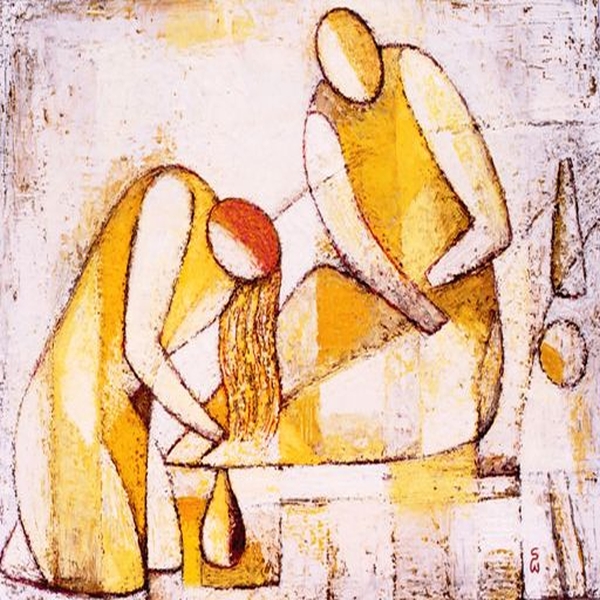
In this story are you the Master. The one who accepts graciously the richness of those who give out of their poverty but in so doing showing the overabundance of their love which cannot be exchanged into any earthly currency.
Or
Are you one of those who are cranky, indignant and disappointed with the way the dinner party is going?
Or
Are you the woman who only has a solitary vase of ointment and so many tears?