Lent 3 March 3rd
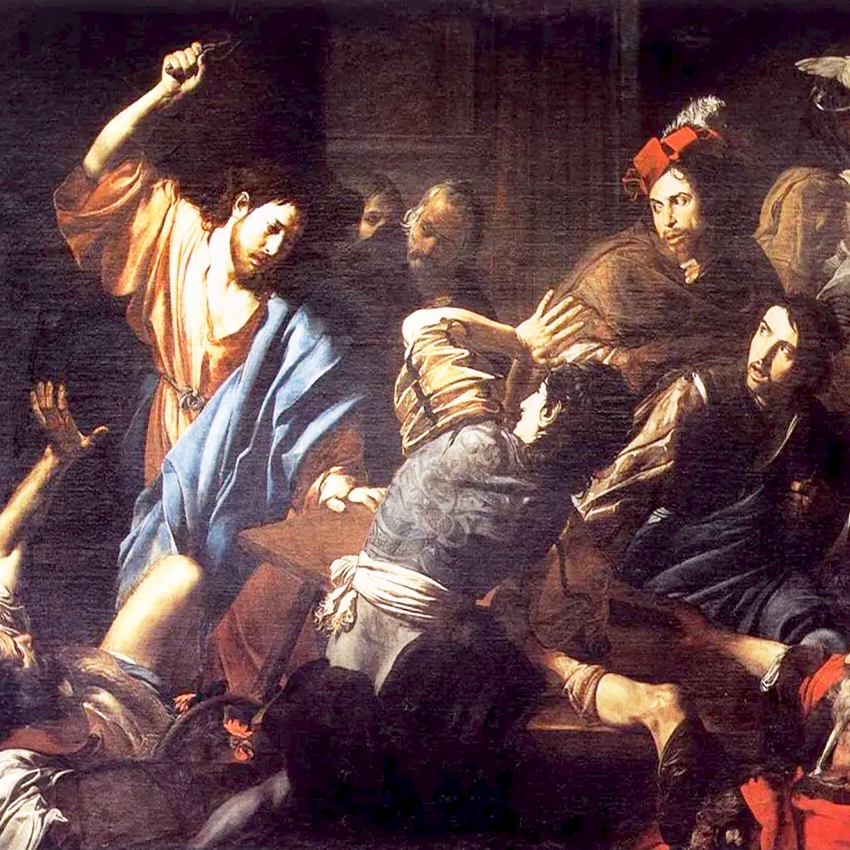
Jesus overturns the money changers' tables
They followed him. With all sorts of motives and for all sorts of reasons. Some were anxious or battling pent-up anger. Others were excited, bewildered or bewitched. The kettle was boiling. Hissing insistently. But no one could lift it from the heat. There was an incessant whistling in the air that people simply couldn’t ignore.
His tears had passed. His vision was clear. Through the winding streets of Jerusalem, he went, striding out, purposeful, determined. Nobody spoke to him. The joy of his entrance had been overtaken by the foreboding over what he was going to do next. Everybody sensed where he was going. But nobody said anything or knew why. They followed in the slipstream of his resolve.
When the outer walls of the Temple came into view, he stopped. And abruptly. It was as though an invisible wall had halted his progress and held him in check.
Why did he stop? Was it the enormity of it all, or his own doubts, fixing him to the spot? Or was it God’s much trumpeted but rarely seen compassion presenting him with a choice?
The crowd behind him muttered under their breath. Everyone had their own theory. Nobody was very sure. Conjecture and assumption filled the air. What was going to happen now? What was he going to do?
He took a deep breath, holding the air in his lungs as if it were a last breath. He looked around him, his eyes beckoning his followers to come close. None of these so-called chosen twelve disciples looked very courageous then. They shuffled forward. He wanted them with him, but he offered no instructions.
Then he moved. Striding forward towards the Temple. Through the gates and into the outer court of the Gentiles, the place where money is changed and animals for sacrifice are bought and sold. It was its usual hot bustle of people and noise. What had once been a quiet place where all the peoples of the world could come and pray (the inner court was, of course, reserved for the Jews) had now become a market place for the necessary business of getting the right money for the right animal for the right sacrifice that would make peace with God. Beyond it, invading the nostrils and cancelling out the perfume of the spring flowers, was the stench of death. Behind the walls and in the Temple itself, pigeons and goats were being killed. This is what sacrifice entails. Throats are being cut. Blood being spilled. Entrails dropping. Flesh burning. The whole macabre round of covering your sin and making your peace, day after day, year after year, death after death after death.
Suddenly there was violence and foreboding in the air, and it emanated from him. He was a tornado, a whipping frenzy of righteous rage amid all this commerce and clamour. He was turning over the tables of the money changers, lifting them with both hands and sending them crashing to the ground, pushing them this way and that. He was upending the benches where those who sold doves were going about their lawful business. His stamping feet were beating out a rhythm of change and putting his mark upon the place.
Gold and silver coins tumbled to the floor and sparkled in the dust. Greedy hands stretched out to grasp them. Doves and pigeons shackled on death row received a last-minute amnesty as their cages crashed to the ground. A few stretched their wings and soared into the sky. Surprised by liberation, and ill-equipped for freedom, their wings diminished and forlorn, and others pecked among the dust. Wasn’t it ever thus? Why is darkness so attractive? Why are prison walls so safe?
It happened so quickly that half a dozen tables were thrown over before anyone even tried to stop him. It just happened. Everyone was too surprised and too bewildered even to move, let alone prevent him. He passed through them like the angel of death itself, deftly extinguishing light after light, and for a moment no one could lay a hand on him.
But now people saw him. It was Jesus. The Nazarene. Mad after all.
People screamed and laughed. Some ran for cover. One vomited in fear.
Others had him in their sights. Some of the money changers whose tables were further into the court hurriedly gathered up their profits in their arms and stuffed their money into leather purses and ran. Others were ready for a fight. They stared with icy opprobrium at his advance.
And now people were trying to stop him. Hands reached out to detain him, to catch hold of him. People stepped in his way. But it was still happening too quickly. It was too confused.
Jesus was at the centre of a maelstrom.
The tables were upended. Fights were breaking out. But most people were more concerned with saving their money or grabbing a piece of the action than actually stopping him.
Around him his disciples looked dumbfounded and inept: incapable of joining him, they were equally incapable of stopping him. Those who recognized them as followers of Jesus screamed at them out of their own frustration and displeasure.
Children cried and turned to find their mothers. Mothers cried and turned to find their children. Old men closed their eyes.
He swept through the courtyard like a man possessed of God, as if the Temple itself was suddenly being made redundant.
And then he stopped.