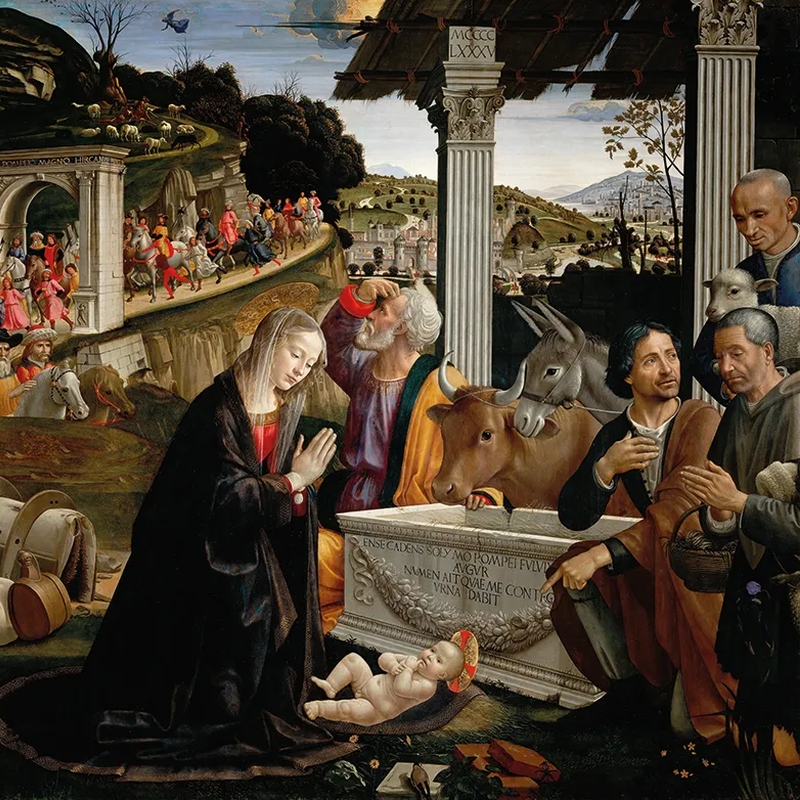
We continue with the reflections on ‘The Faces She Saw’.
And we’re thinking about some of the faces that Mother Mary saw in the lead-up to Christmass.
Today it is the Shepherds. Bishop Stephen Cottrell wrote this one for me and I unashamedly filched it from his book “Walking Backwards to Christmas.”
“We went into the stable then. The door wasn’t barred. It was open to us – and, I suppose, to the whole waiting world.
We went in and knelt down. That's all we did. Fools and idiots, who for no reason of personal merit or insight had just received the richest fortune. We knew this. And we didn’t need to say anything. We saw the child and the child’s mother. We saw her husband. He stood between us and the child for a few moments, but as we were on our knees there was not much to be frightened of – we were hardly a threat, despite our rough appearance – so then he smiled and beckoned us forward. We shuffled across the floor on our knees. It must have been comical to watch. We must have looked at a real sorry sight. But it felt right. This was not a place to stand; this felt like a holy place – like when Moses saw that burning bush and took his shoes off. this was not a time to speak. Whatever God wanted to say to us that night, he was saying it in the silence of a child born. All the noise and rejoicing of the angels was to lead us here, deep into the silence of God’s presence.
And there we stayed. For what seemed like ages. Kneeling and staring and smiling. then, because none of us can bear too much reality for too long, and love to tell a story and share a joke, we rose and shook each other’s hands and introduced ourselves. There was laughter and tears. I don’t know how to describe it. We all spoke at once, and our strange stories of angels in the sky directing us here seemed to confirm their strange story of an angel’s direction and the message that this child was from God. And though I don’t pretend to understand why God would visit us here, in this way, in this dismal place, I can’t deny that there was something magical in this night that words can’t contain. Even as I tell you what the angels sang and how the sky was filled with light, it seems in part like someone else’s life, or a story made up to emphasise that what happened was fantastic. All I know, and what I am left with, is the child: his silence and his presence and the adoration of his mother and the tenderness of love given and received.
Many words were spoken that night. When we left the stable as the new day dawned we were rejoicing – more drunk than any liquor had ever made us. We talked about it to everyone we saw. We shouted it out. We said a king was born, a Messiah. And they laughed, winked, patted us on the back, and got on with their lives like nothing had changed. Even the crabby old woman who runs the inn opened her door a fraction to glare at us. ‘Peace on earth,’ we said to her, laughing. ‘A new king born, here in Bethlehem.’
Who listens to a shepherd if he is not King David? Who listens to a child when a child cannot even speak, but only sleep and cry? And if this child is king, how will anyone know? Will he be like David and lead an army to victory, kick out the Romans, and establish an empire? I can’t see it. not in this manger where he lies at the moment. this is a different sort of king.
But what do I know? A shepherd, an outcast: a dreamer of smutty dreams and cheap thoughts, a lover of wine and generous women? How can I know the mysteries of God? or what God is saying through this child? But I do know this, and I will hold on to it, even if no one believes me, and even if I have to keep it to myself for ever: a word was spoken tonight, but as the night turned into the day I realised that it was not the words of the angels, nor our excited words of greeting, nor even the astonishing obedience of a mother who endured all the misunderstandings and the hardships that had brought her to give birth in a barn. It was the word of God: God’s word spoken in the life of a child.”
“God does some of his finest work in the muck that is you and I.”
This line was forged in my struggle to write a homily. I was reflecting upon that moment in history when for the very first time Mother Mary must have placed her child onto the squalid straw of the manger. In this one swift moment, two things happen. The first thing is that Christ becomes available for everyone. Secondly, God is now in our muck. Unavoidably inextricably, He is one with us in all our grubbiness and shabbiness. There is no situation, no place, or loneliness, where God can be absent. That’s the gist of what I was trying to say in my homily.
But in the smithing of the homily, another phrase emerged from the smelter.
“God does some of his finest work in the muck that is you and I.”
The cute nativity scenes have got it all wrong. The message of the manger, the very manky manger, is that The Almighty wanted to be planted in our mess. He longed to be immersed in our humanity and not held at a distance in inapproachable light. Flesh and spirit are not at war and on opposite sides of the universe. They are united in Him. God plays with and in, the dirt of our humanity. He will fashion us into something quite remarkable if only we allow ourselves to be pliable and amenable to his plan for us.
Deep in the bowels of the muss and muck that is you and I, is precisely where He wants to be. It is where He already is. By being planted in Mother Mary’s womb as an embryo, God shouts his resounding ‘Yes’ to us, just as surely Mother Mary said her ‘Yes’ to Him.