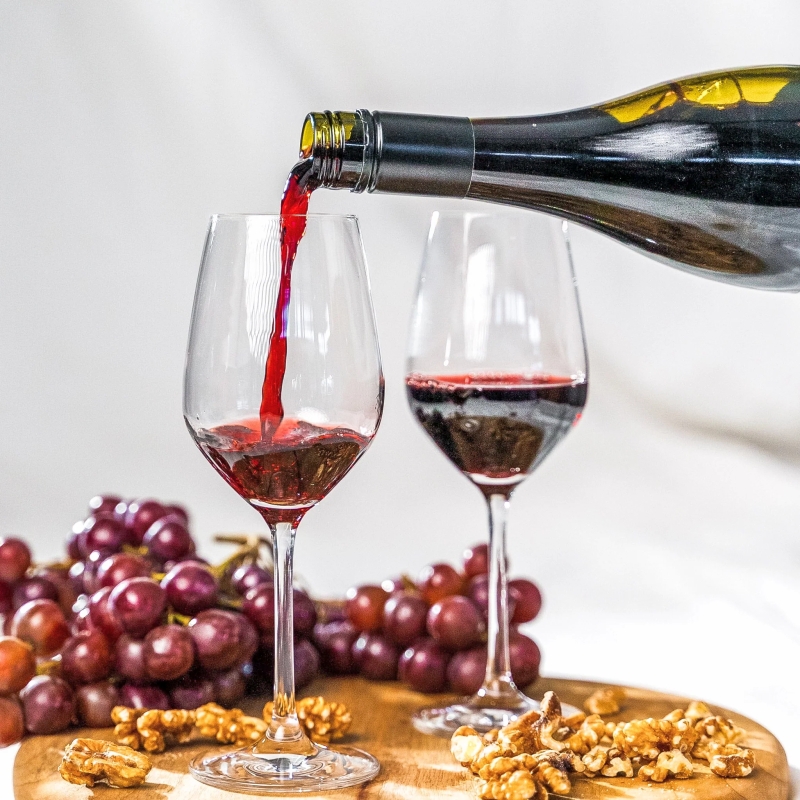
Bottles of show wine
The classic interpretation of this parable goes like this. It is the history story of our salvation in four, easy to understand, any idiot priest could get it.
First, it looks back at Creation and the choosing of the land of Israel: “There was a landowner who planted a vineyard… put a fence around it, dug a wine press in it, and built a watch-tower.” From the very beginning, God began to reveal himself and his plan of salvation through his caring act of creation. The second part of the story involves the sending of numerous prophets, including Moses, Issac, and Jacob right up to John the Baptist: “When vintage time drew near, he sent his servants to the tenants to obtain his produce…” The prophets were men of God’s word, calling the people back to the Law and the covenant, but usually with little success and often to their own peril. So we get “But the tenants seized the servants and one they beat, another they killed, and a third they stoned.” Which is of course Jesus taking a very thinly veiled swipe at the Jewish authorities and their treatment of those who have gone before him. Not surprisingly we can almost hear the leaders blood pressure rising and their hearts beating angrily as they realise that Jesus is really talking about them.
Chapter three; God sends a final messenger: “Finally, he sent his son to them…” The Incarnation, God becoming flesh ushers in the final age, in which redemption is offered to everyone. Or as someone far more eloquent than I put it. ‘The church of God has everything to do with everybody.’ … ‘The church of God… has everything… to do with everybody.’
The fourth and final part refers to The End and is presented as a question: “What will the owner of the vineyard do to those tenants when he comes?” The religious leaders of the day condemn themselves with their own words
They said to The Master ‘He will put those wretches to a miserable death, and lease the vineyard to other tenants who will give him the produce at the harvest time.’
And you see there is also a transference here from the religious leaders of the day to The Master himself. The succession of the Kingdom from Israel to the Christian Church. But more than that, there is a broadening and there is a deepening. The Kingdom is broadened to encompass the entire world, and it is deepened in that belonging to it is not a matter of geography or grace. The life of the family of God is not found in human genealogies, but in the gift of Trinitarian life through the Incarnate Son of God
And that four-chapter story is right and good and proper. Usually, the preacher will go on to say that we are now the tenants and it is up to us to produce some yummy, high-quality show wine. Further, we need to be on the lookout for those who approach us and are the people sent by God to challenge us, to inspire us and maybe even to tick us off. I am sure that God continues to send people to our vineyards who see us with fresh eyes, to offer us a different insight and perspective. And while it might make us feel a little uncomfortable, it is an opportunity for us to try again (maybe) in a different way, with different gifts.
I would add the following insights for your reflection.
We hear much about the housing shortage in the media… of landowners and tenants and we hear much about the rights of folk to housing. What if we turned the whole thing on its head and said that this was not a matter of landowners and tenants and rights but rather it was simply a matter of …responsibility? I wonder whether that would change the debate and the dialogue?
Both from a landlord's and a tenant's perspective there is a lot of trust and a lot of waiting around. God has entrusted us with a humbling amount of responsibility to produce the wine for the good of all.
And yes we watch, we wait, we pray, but everyone has a place in the vineyard, everyone has a job to do and everyone has a place at the table to enjoy the fruits of our work.
Our fruits will be ones of trust patience and prayer. Our attitude at the front gate of the vineyard is to be gregarious and welcoming. When we accomplish this, the better our wine will be and the more plentiful the harvest will be.
A story and a question to finish with.
Most of you will know that before I went to college I had the marvellous job of being a tour guide at a winery and I was astonished to learn how long it took to make a very good bottle of wine. Years and years. The vintages that I was there for, would not be enjoyed until after I had left the winery and was safely ensconced in college.
Which is a jolly nice, but not-so-subtle way of asking... In a couple of decades' time, what sort of wine will we have left for future generations?