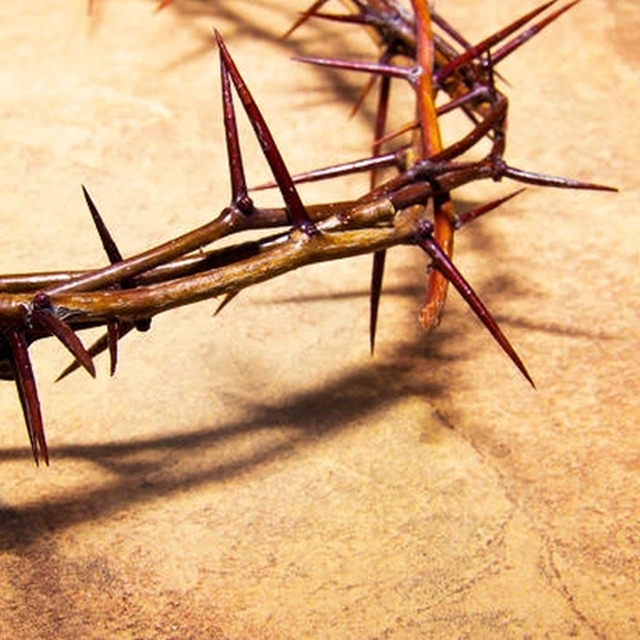
A crown of thorns
Bishop Stephen Cotterell
The soldiers’ logic had a brutal simplicity. A cruel, schoolboy logic. He said he was a king, so dress him up as one. A purple robe. Some twisted thorn. A makeshift crown. The barbed wire of the bush. Harvest it gingerly. Put that in your pipe and smoke it. Stack him up. Salute him. Stretch him. Strike him. Scratch him. Scar him. Skewer him. Scoff and mock him. And afterwards smiling at each other, wink and reminisce. A cracking good joke.
They made him a kind of pantomime king. Something to laugh at. Something to scorn. They bowed before him and grinning they worshipped him. Then they beat him.
They had their way with him. They made fun of him in the way that bullies easily do when there is someone defenceless in their midst. Someone who won’t fight back. Someone who’s a bit different. Someone who makes claims that are easy to mock. His silence convicts him.
They wanted him sorted. They wanted him to be put in his place. But they didn’t know where his place was. ‘Not of this world’ they had heard him say. Well, this was one dreamer they would haul back down to earth. They would reel him in. What had his dreams achieved? Just more trouble for them.
The crowds were always bad at this time of year, stirred into a ferment of religious excitement and anticipation. He had made matters worse. Did he expect them just to leave? The mighty Roman Empire to roll over? What sort of revolution could this dreamer roll? They could crush him so easily! He was a grasshopper under their feet. They would stamp him out.
And where were his followers? Abandoned him, every one of them. A king, indeed! They would show him. They would do him honour. They would make him a crown. And dressing Jesus as a king was such a wonderfully good joke that, like all good jokes, like every piece of well-honed gossip, it soon had legs. It travelled down the corridors of Roman power from soldier to soldier, even to the ears of Pilate. ‘Are you a king?’ he enquires with a smile. And when he leads him out before the people: ‘Here is your King!’
The crowds spit back their curt reply. Laughing. Sneering. We have no King but Caesar.
Pilate then issues instructions for a sign to be put above the cross saying ‘Jesus of Nazareth, the King of the Jews’. And so that everyone can get the joke, he decrees that it must be written in three languages – Hebrew, Greek and Latin. All the world can now enjoy the joke.
But then the joke reaches the ears of the High Priest. And he isn’t laughing. Jesus’ silence never quite speaks to him of a broken man; rather he is disturbed by his silence, confronted by his presence: it is almost as if he is judging them. ‘Don’t put King of the Jews’, he intervenes, ‘but this man said he was King of the Jews.’ So they stare each other out. These two big men. These occupying forces: are one of the present and one of the past, but neither has the future in control. But it is too late. It has been uttered. ‘What I have written, I have written,’ retorts Pilate.
When I am lifted up from the earth …
He is a king: a piercing beam of light for all the world: the very one that all Israel has been hoping for, waiting for; the one to whom all their scriptures and their prophets point. All the troubled searching of this nomadic nation, their deepest longings and the keenest insights of their brightest minds, have come down to this man and been refined into this moment. But they don’t see it.
They laugh out loud instead. Even those who have caught a glimpse of who he is are now cowering in fear, hanging onto their own lives and reputations, getting ready to go back to how it was before him.
There is a further twist: those he has come to save now hurry to get a better view of his dying, sneering at his stupidity. What sort of a king is this?
Even as he hangs there, the life draining out of him, the taunts come thick and fast. ‘He saved others, but he cannot save himself!’ Even one of the criminals crucified with him joins in the fun: ‘Save yourself, and us as well,’ he scoffs. And in his heart, though no longer on his lips, he carries the words that will get him through the next few hours. ‘My kingdom is not from this world. If my kingdom were from this world, my followers would be fighting to keep me from being handed over. But as it is, my kingdom is not from here.’
The thorns press harder. Blood pumps from the punctured skin, oozes, clots in the heat and the sweat, and flows again. He is faint. His hands are shaking. He slips and falls again. Out of reach. Utterly alone.
The Godhead which is fully alive in Jesus, the crucified, is poured into the lap of uncomprehending humanity. These are the truths the thorns reveal. All our deaths and all our sorrows and all our failures are nailed to this tree. This is our half of the cross. We die with him because he chose to die with us. He carries a crown that all can wear, and the cross itself is our way to travel.
The darkness beckons. The flies buzz around his face. Still, the crowds taunt: ‘Let the Messiah, the King of Israel, come down from the cross so that we may see and believe.’ But how could he come down? The cross that he carries is his throne. He is reigning from the tree.