9/11 and all that
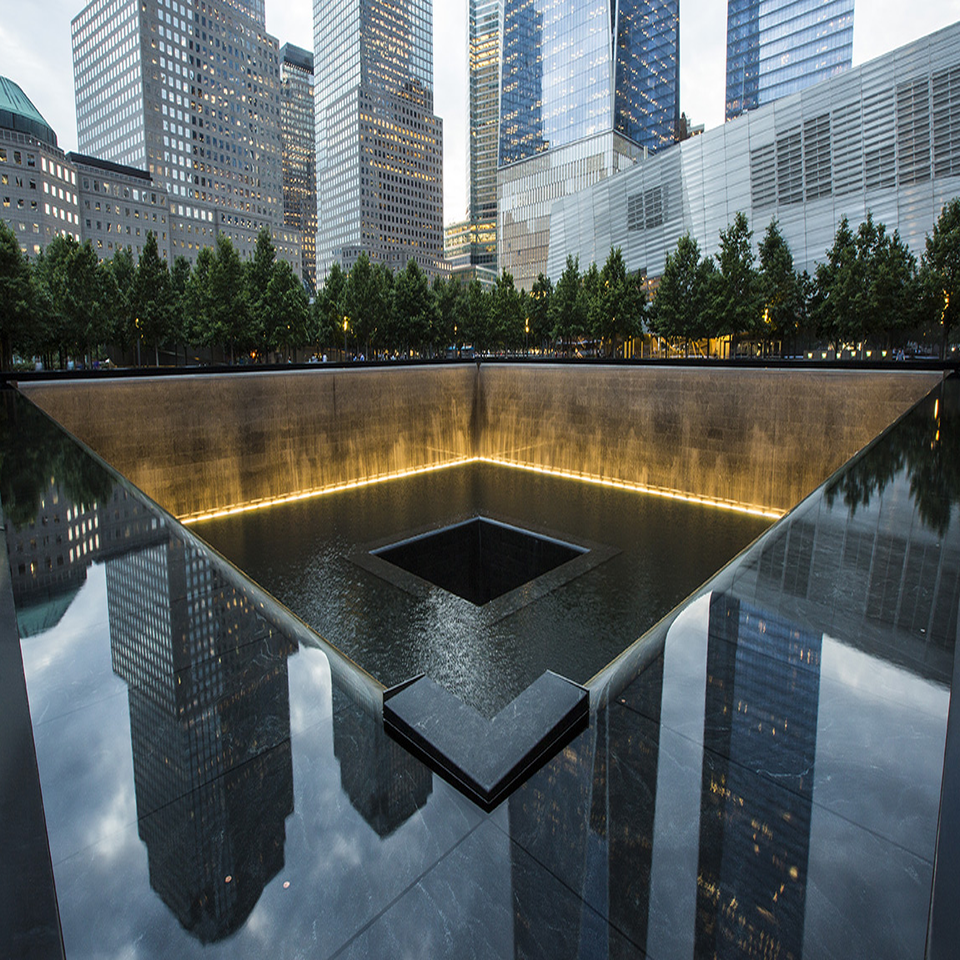
I’m writing this well before we leave for New York, but I can tell you that one of the things I would like to see is the September 11 memorial. Not the museum… that would be far too confronting, but I do want to go and pay my respects and offer my shaky prayers at the place where it all happened. I think I owe my brothers and sisters that much.
I’m told that the memorial has been sensitively created and well thought out. That it is beautifully and respectfully maintained and that on the birthday of each of the deceased, a single white rose is put beside their name.
I am also very much aware that I am a guest there and I will be treading on (gently I hope ) someone else's sacred space.
It also poses the question; What do we, as Church, say in the face of such an atrocity? How do we respond, and how should we respond, as respond we must. Not to say anything would be a failure of duty to proclaim the gospel. It would be very disrespectful to the departed and those who continue to be in anguish more than 20 years later.
What I offer here is not a conclusive, eloquently argued, wrapped up in a nice white ribbon, with meticulous footnotes, piece of work.
Instead, it is a rambling concoction of a few ideas that have come to mind. The rest is up to you to wrestle with and ultimately for God to tidy away.
It all began at Christmass. We learnt that God immersed himself and became inseparable from our humanity. The guy that walked the dusty streets of Palestine all those years ago was fully one of us and fully God. Yes, I can’t get my head around it either. But what we learnt from the child that rolled in Our Lady’s womb was that human life is sacred. It’s holy, it's the very stuff of God and to snuff it out is sin. It's what the commandment ‘Thou shall do no murder is all about.'
Extremism and fundamentalism have no place in our religious life nor in our community. To believe that you are so right and everyone else is so wrong and therefore must go, has resulted in all sorts of hurt and bloodshed over the years and sadly some corners of Christianity have been sucked into this very dark place. Every time we single out a particular race or group and tarnish all of them as being somehow less than ourselves, we stand on the slippery precipice of sin.
By far the most eloquent and helpful response I have found is from another world leader and I offer her words because they are the sort I hope I might write one day.
Notice a few things though.
She never talks about the perpetrators. Instead, the focus is always on those left behind.
She too ‘had no words.' That awful quandary of ‘what on earth do I say?’ is universal. It’s not just a Fr. David incompetency thing and I find that deeply reassuring.
In that lovely paradox of ministry, she finds that those who are visited give her the words she could not find herself.
Finally and perhaps not surprisingly it is the words of the Risen Christ on that first, sublime and mysterious Easter morn that resonates most potently and it is that greeting of ‘Peace be with you.’ that I hope I will remember to mumble in New York.
“What words adequately express the pain and suffering of men, women and children lost, and so many injured? What words capture the anguish of our community becoming the target of hatred and violence? What words express the grief of a city that has already known so much pain?
I thought there were none. And then I came here and was met with this simple greeting. As-salaam Alaikum. Peace be upon you.
They were simple words, repeated by community leaders who witnessed the loss of their friends and loved ones. Simple words, whispered by the injured from their hospital beds. Simple words, spoken by the bereaved and everyone I met who has been affected by this attack.
As-salaam Alaikum. Peace be upon you.
They were words spoken by a community who, in the face of hate and violence, had every right to express anger but instead opened their doors for all of us to grieve with them. And so we say to those who have lost the most, we may not have always had the words.
We may have left flowers, performed the haka, sung songs or simply embraced. But even when we had no words, we still heard yours, and they have left us humbled and they have left us united”.
Or as St. John put it…
Peace I leave with you; my peace I give you. I do not give to you as the world gives. Do not let your hearts be troubled and do not be afraid.