From shame to rejoicing. a homily for the 21st of August
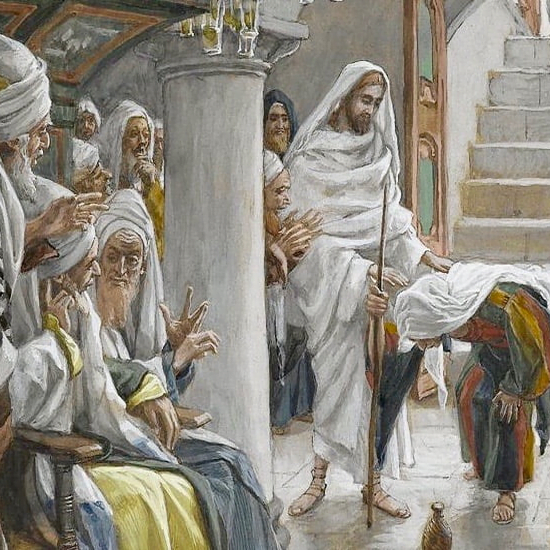
There’s a fair amount of shame slushing about in the synagogue story today.
There is the shame of Jesus' opponents
“When Jesus calls out his opponents they were put to shame;”
There is the shame of the woman who is stooped over. It cannot have been easy for her, what with the gawping of the people in the synagogue., to say nothing of the spiritual inhibition.
All this shame is heightened by the attitude of the leader of the synagogue. This guy really needs a bit more experience under the tutelage of a very wise and senior priest together with a goodly amount of selected informative reading. The gospel does not paint him a very good light.
But shame is not the only issue congealing in the synagogue on that warm summer sabbath. There is also the question of authority.
Who is in Charge?
Is it The leader of the synagogue?
Is it Jesus?
Or maybe, and this might sound a little odd, maybe there is a sense in which it is the woman herself who is in charge. Just by showing up and being there. Surely that is a visible sign of courage, resilience and faith. That is a sign of her authority. No wonder she is open to the possibility of healing and is ready for her life to be turned around.
The leader of the synagogue challenges Jesus' authority because his own authority is threatened. And his authority is rightly threatened, for he has missed the main thing. It’s not about Him, the leading parish rabbi, it’s not about the rules for healing on the Sabbath.
The really important people in this sorry little story are the woman and Jesus.
Jesus knows this and calls the woman to him. That is why Jesus' authority trumps the rabbi’s misguided sense of self-importance.
So what does all this have to do with us in the year of Our Lord 2022? There has always been opposition to God’s kingdom. This opposition comes in a myriad of ways and forms. Sometimes it’s obvious and blatant and sometimes its subtle and imperceptible.
It's why we must always be alert to this opposition and we must always be alert to the signs of God’s kingdom coming among us. We must seek to bring God's kingdom into the world. When we pray ‘your kingdom come’ it means that we have an obligation to try and make it happen in our community, our parish, our life and the lives of others.
And we must always pray that his kingdom come, even when and especially when it doesn’t feel like it when we can’t see it and there seems to be harsh opposition to God's kingdom.
Please note Jesus has a lovely and refreshing disregard for the rules. He heals and challenges and delivers when and where he wills. And it often seems that it is the least likely people that he calls to himself. Those stooped over by prejudice or misunderstanding. It is the vulnerable and the unnoticed that he touches, releases and heals. It is the impossible cases, the hopeless and the hapless. The woman in today's gospels had this affliction for no less than 18 years. Even the smartest specialist, the most persistent and diligent doctor would have pretty much given up on this case and there is a nasty little bit of us that might well have also given up and been dismissive.
And what is more insidious and dangerous is that sometimes we can write ourselves off as a hopeless cases. That there is nothing I can do about this itchy little habit that I have been trying to give up and it inhibits and stunts me and I’ve had it for years. It is to people like this, people like you and me that Jesus calls to himself and in the face of denial and resignation heals and liberates. It is terrifyingly easy to trot out our mantra of “oh well that’s just the way I am … or ..oh well that's just good ol so and so and they have always been that way.
Jesus calls the woman to himself.
“When Jesus saw her, he called her over and said, ‘Woman, you are set free from your ailment”.
The Master sees us as we are; sometimes we are bent over with our shame which inhibits and stunts our potential and our growth. Sometimes we are just bent over with weariness.
We are not as we should be. We are not the people we are called to be and we need to be very careful not to add to people's shame (clergy especially), but rather wherever and whenever, at every single possibility we ought to be vigilant and actively seek out opportunities to release and heal and liberate all manner of people. Then at our synagogue and in our world, we may move from shame to rejoicing. Then God's kingdom will come and the opposition of fundamentalism and rigorous authoritarianism will be vanquished. Then we can all stand up straight confident in God's love and proclaim his healing power to the world. We will in fact have gone from shame to rejoicing.